
One of the most sought-after jobs in the U.S. healthcare industry is that of a physical rehabilitation therapist. This is an option to consider where you want a career with purpose and with career wage/predictable demand. Physical rehabilitation therapists treat patients to aid in the recovery process after an injury, illness, surgery or disability. They also include the involvement of the elderly in their old age and ensure their independence. It’s a job that’s all about science, on-the-job training and real people – all day, every day. Many choose to change their career to become a physical rehabilitation therapist or they are intending to change their career from high school. Whatever the case may be, there are definite actions you will be able to take if you know them. Instructions step-by-step to cover all bases – from first college class to the end of your state’s licensing process.
Becoming a physical rehabilitation therapist is no quick job, but it’s one that is well worth doing. A bachelor’s degree, a doctoral program and passing a state licensing exam are required. Explanations of each step in this guide are simple. You will also discover about daily responsibilities, essential abilities, and up-to-date salary information.Finally, you’ll be able to grasp the career path of a physical rehabilitation therapist and be able to be successful with assurance.
What does a Physical Rehabilitation Therapist do? (Role, Definition & Overview)
Physical rehab therapist is a licensed health care practitioner. They allow people to walk better as well as cause less pain. A patient can suffer from an injury, disease or disability. Physical rehab therapists work with patients of all ages. This can be babies, teens, adults and older people. Patients wish to recover post surgery. Others just want to walk without any pain. This career is a combination of science and emotional support for humans, making it a fulfilling career for many employees.
Many people refer to this as a physical therapist (PT). The title varies but the work remains the same in most U.S. states. A physiatrist has a unique treatment plan for every patient. The aim is to give the patient his/her mobility back and enhance his/her life. Generally work alongside doctors and nurses, and other health professionals. This partnership enables each physical rehabilitation therapist to offer the best patient care and best outcome.
How to Become a Physical Rehabilitation Therapist. The role of the key duties and responsibilities will be clarified.
A physical rehabilitation therapist is involved in numerous activities every day. First, their first step is to look at doctor notes and medical history. Next, they observe the motion of a patient. That assists them to pinpoint the actual cause of their pain. Then, they design a treatment plan that is unique to every patient based on their treatment goals. Manual therapy or therapeutic exercise may be used to develop strength in this plan. The aim is to enhance the mobility of patients and reduce pain gradually, day by day.
A physical rehab specialist also monitors progress over time. They adapt the plan as the patient becomes stronger or weaker. They provide education for patients and families regarding how to continue improving outside the healthcare facility. Other doctors do look at good notes and clear records, too. Here are some typical everyday activities of this job:
- Examine patients’ history and referrals
- No physical test for movement, strength and balance.
- Develop a unique treatment plan.
- Have therapeutic exercise and hands on care.
- Monitor and document patient’s progress.
- Educate patients on prevention of injury.
Physical Rehabilitation Therapist Career Path – How to Get There Step by Step
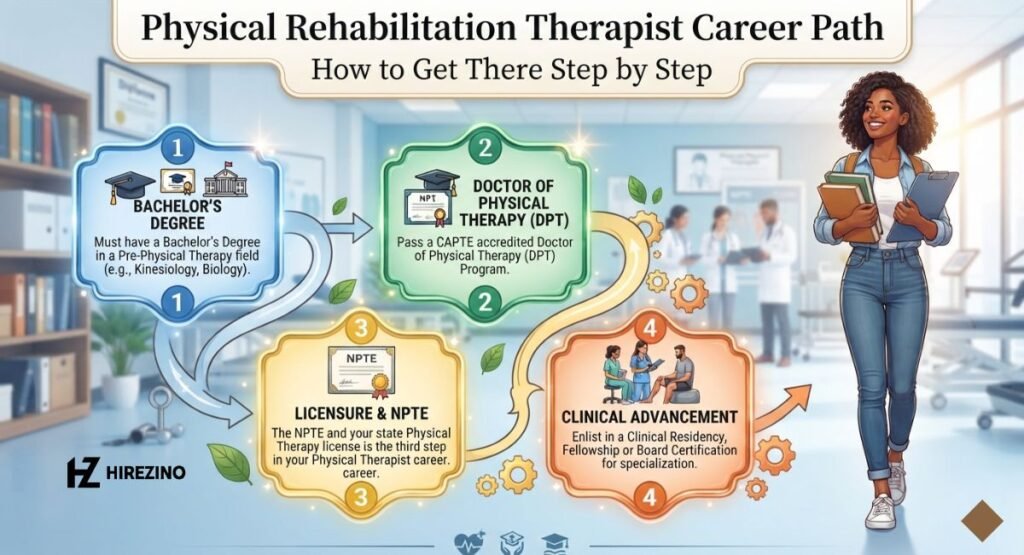
So, how to become a physical rehabilitation therapist? There are evident, clearly specified steps on the path. There are 7-8 years total from college to licensing. You begin your education with a Bachelor’s of Science degree. Next, you undertake a doctorate tailored to this profession. Once you have undergone the state exam, however, you’re ready to treat patients on your own.
You can not skip steps, each step relies on the previous one. Early planning is so important for future students! To become a physical rehabilitation therapist, follow the steps below, starting with the first step. The table below provides a quick look at the entire process, from the first college class to the final license.
| Step | What You Do | Typical Length |
| 1 | Earn a bachelor’s degree | 4 years |
| 2 | Complete a Doctor of Physical Therapy program | 3 years |
| 3 | Pass the NPTE and get your physical therapy license | A few months |
| 4 | Optional residency, fellowship, or board certification | 1+ years |
1st step: Must have a Bachelor’s Degree in a Pre-Physical Therapy field.
College is the first step to being a physical rehabilitation therapist. Requirements for admission to doctoral school are a bachelor’s degree at least. Kinesiology, exercise sciences or biology would be good majors. These majors will contain basic science courses that will be required for other majors. A double major can be taken to add to students’ options. Others concentrate on good marks in a few fundamental science disciplines.
The Ph.D. programs are looking for students that have good grades and hands on experience in science. These four years can be devoted to the study of Anatomy, Physiology, Chemistry and Physics. It also includes a shadowing experience in a local physical therapy practice. Later, you can use your physical rehab experience and practice to your advantage when applying for the job, and you’ll be able to help ensure that you’d want to have the job.
The 2nd step is to pass a CAPTE accredited Doctor of Physical Therapy (DPT) Program.
Then, all physical rehab therapists need to get a Doctor of Physical Therapy degree. This is called a DPT and is the lowest that is required now days. The program has to be accredited by CAPTE. This is the official U.S. standard of physical therapy schools and is a patient and student protector. Even if you get good grades you should not do this step, because you will not be able to pass the licensing exam later.
The length of time is a typical three year DPT program. Neuroscience, pharmacology and biomechanics will be in detail studied. You will also have first-hand experience of working with a patient for which you have control. This hands-on course prepares ALL physical rehabilitation therapists to be confident and clinically competent well before their first day on the job.
3rd step: The NPTE and your state Physical Therapy license is the third step in your Physical Therapist career.
Even if you have finished your schooling, it is still necessary to have a license in order to be able to work legally. A physical therapist must be licensed in every state in the United States if he or she is a part of the patient’s therapy. The latter is only accomplished by passing the NPTE. It is the National Physical Therapy Exam and must be passed nationally. The test will show you that you will be ready to work with real persons safely as a physical rehabilitation therapist.
Some states have extra requirements to the national exam. This can be a law examination, ethics examination or criminal background check. When you’re prepared to meet all the requirements you’ll be qualified to practise physical rehabilitation therapy in your state. Depending on state and time, requirements may change so please consult your state licensing board.
Installation Step 4: Enlist in a Clinical Residency, Fellowship or Board Certification.
Some professionals after getting the license choose to further advance their careers. A great number of the new graduates pursue a clinical residency. Typically requires one additional year of additional training. This enables a physiotherapist who has specialized in rehabilitating the body in a particular field like sports, orthopedic or neurological. Not required but may be offered and/or result in special clinics and roles.
A national exam is also available that will lead to the awarding of a board certified specialist’s title. Excellent practice and understanding in a particular aspect of practice. Not necessarily legal, but can be done reasonably to advance your career and salary. A lot of patients also trust a certified physical rehabilitation therapist more, as it indicates a proven and tested knowledge.
Essential Skills Every Physical Rehabilitation Therapist Needs to Succeed
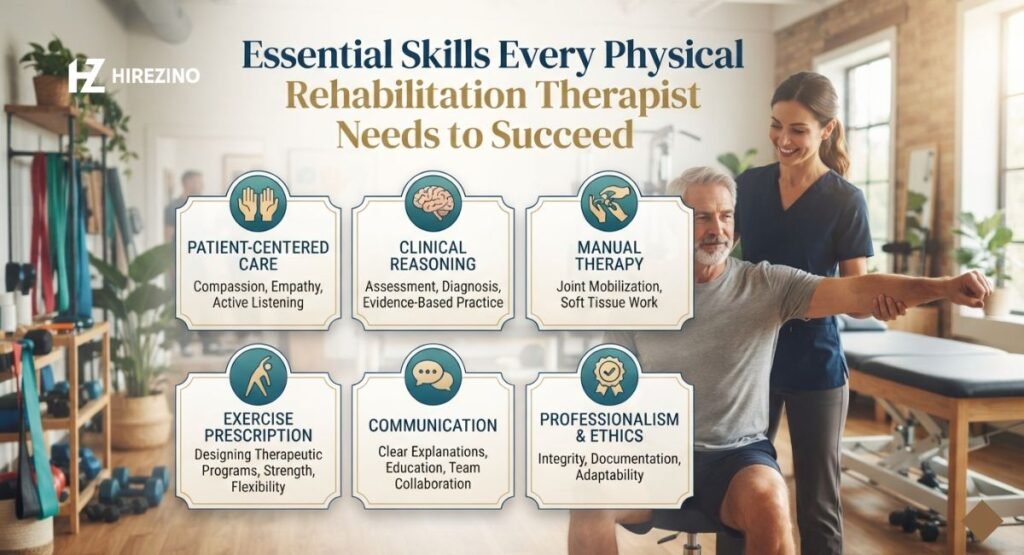
There is more to achieving success than getting good grades. Each day, a wonderful physical rehabilitation therapist has to be physically fit, with good soft skills. The importance of communication as patients need to be given simple and easy to follow instructions. Plans should be conveyed to worried and troubled patients in an apocalyptic fashion. You also have to be compassionate – many of the patients are in pain, fear and/or frustration during the recovery process.
It’s not only the clinical knowledge, attention to detail is important as well! Often a small ‘hint’ about how the part or parts need to move can lead to the discovery of the real underlying cause of the pain. But, the physical rehab therapist will require physical endurance, as well as solid and reliable hands for many hours every day. Until the young person is ready to work, Best Practice Skills are the most essential skills they should acquire to begin building their career:
- Clear, calm communication
- Compassion and patience
- Attention to detail
- Coordinate hand/finger movements to play instrument effectively and with ease.
- Not taking too long when on fire or emergency situations.
- Adaptability to making use of every treatment plan
Below are the estimated salary and job information for Physical Rehabilitation Therapists for 2024-2034.
The PAIR’s condition in the USA is fair. The median annual wage in the U.S. was approximately $101,020 in 2024, according to the Bureau of Labor Statistics. Those with the highest incomes earned more than a year of $132500. Wages are based on the job’s location, state and years of work in the job. Curious how this compares to other allied health careers? See how much ultrasound techs make in a similar timeframe.”
The job outlook is even better news for future students entering school now. Jobs for a physical rehabilitation therapist should grow about 11% by 2034 nationwide. This is much faster than most other jobs across the entire U.S. economy. Demand is rising fast due to an aging population that needs more care. More people need help with patient mobility as they grow older each year, which makes now a smart time to start this physical therapy career.
Conclusion
There is a clear and solid course for a physical rehabilitation therapist, but work and time will be required. You have a bachelor’s degree in a science-related field (e.g. Biology, Kinesiology). You then go to a physical therapists accredited school of the doctorate degree. After this, one has to pass NPTE in order to be licensed as physical therapist. Other professionals opt for a residency or for a board-certified specialist later in their careers. True skills and confidence gained step-by-step. The steps also help to take you closer to helping a real patient day after day. This is not a quick road, but it’s the one that is reliable. You can be a physical rehabilitation therapist, and have a respected role in U.S. healthcare, in order:
For the majority of people the reward for this trip is worth it. Physical rehabilitation therapists make very nice incomes – the median is more than $101,000 a year. When compared to many other careers, the growth is also strong for this career, increasing at 11% until 2034. There is continued demand as there is an increased need for mobility assistance services every day with patients. You also have a purpose, and each of the treatment plans you develop can change a patient’s life. The job of a real estate agent is one of the few careers that has a stable pay, job outlook and impact on people. If you’re ready to assist people to heal, begin your journey now. Explore physical therapy schools in your area, and start your journey towards your future as a physical rehabilitation therapist.
FAQ’s
How long does it take to become a physical rehabilitation therapist?
It typically takes seven to eight years total. This includes four years for a bachelor’s degree and three years for a Doctor of Physical Therapy program, plus time to pass the NPTE licensing exam.
Do you need a doctorate to become a physical rehabilitation therapist?
Yes. A physical rehabilitation therapist must earn a Doctor of Physical Therapy (DPT) degree from a CAPTE-accredited program. A bachelor’s or master’s degree alone is not enough for licensure.
What degree do you need to become a physical rehabilitation therapist?
You need a bachelor’s degree in a science-related field, such as kinesiology, biology, or exercise science, before applying to a doctoral Doctor of Physical Therapy program.
How much does a physical rehabilitation therapist make per year?
The median salary is about $101,020 per year in the United States. Top earners make more than $132,500 annually, depending on setting, state, and experience level.
What is the job outlook for a physical rehabilitation therapist?
Job growth is projected at 11% through 2034, much faster than average. Demand is rising due to an aging population that needs more help with mobility and pain management.
What is the difference between a physical rehabilitation therapist and a physical therapist assistant?
A physical rehabilitation therapist evaluates patients and creates treatment plans, requiring a DPT degree. A physical therapist assistant carries out those plans under supervision and needs only an associate degree.
Is becoming a physical rehabilitation therapist worth it?
Yes, for most people. It offers strong pay, fast job growth, and a meaningful career helping patients recover mobility and independence, though it requires several years of doctoral-level education.