
Outsourcing vs. One of the most significant choices in the growth of a company is your In-House IT Team. All businesses require IT support, and their choices of support differ. If you are responsible for the functioning of your own IT department, employ full time employees and manage them on a daily basis, then you are a manager. Do you use an external service for your systems, security and support desk? This decision can impact your budget, your speed, and your future growth. Too often business owners make a hasty decision without considering the facts of a trade-off. This frequently results in wasted money or inefficient and frustrating support further down the road. This guide takes you through both sides in a clear and concise fashion, using language that anyone can understand and real numbers that will tell you what each one means for a business such as yours before you take the plunge.
A small start-up may not have a budget of a few hundred thousand, whereas a large company may have specific compliance standards and sensitive customer data. Some companies even combine both, adopting a hybrid approach of having a central strategy and delegating tasks that are more routine to an external support service. In this article, we’ll analyze the advantages, disadvantages, and the actual expenses of outsourced IT vs. an in-house team, and the biggest pitfalls that businesses encounter when they are deciding which path to take. At the end, you’ll have a clear and actionable plan to make successful decisions with regard to your business, your budget, and your future growth.
What Is In-House IT vs. Outsourced IT? (Key Differences Explained)
Let’s start simple. An in-house team means you hire your own IT department. They work at your office. They know your systems well. This is one side of the Outsourcing vs. In-House IT Team debate.
The other side is the provider who is outsourced. This is commonly known as a managed service provider (MSP). You pay them a fee. They remotely manage your infrastructure management, cybersecurity and help desk requirements. The genuine issue in Outsourcing vs. There is no better or worse, In-House IT Team is. It’s which one’s best suited to your business size, budget and goals. Small companies tend to be leaning-out. For large companies that have more complicated requirements, they may have an in-house team. When you get to making a wise choice later in this guide, it will help you to understand this split fundamental.
Pros and Cons of an In-House IT Team
An in-house team gives you full control. You see your staff every day. They understand your company culture. This builds strong business alignment between IT goals and company goals. In the Outsourcing vs. In-House IT Team comparison, this is the biggest win for in-house.
But there are real downsides too. Salary and benefits add up fast. Recruitment costs are high, and hiring takes months. One employee can’t be an expert in everything. There’s a real skills gap risk. Coverage is also limited. Most in-house staff work 9-to-5, not 24/7. When it comes to Outsourcing vs. For busy companies that require assistance at all times, this missing coverage can be a decisive factor for In-House IT Team.
| In-House IT: Pros | In-House IT: Cons |
| Full control | High salary and benefits cost |
| Strong business alignment | Slow hiring process |
| Fast on-site help | Limited skills gap coverage |
| Deep system knowledge | No 24/7 coverage |
Pros and Cons of Outsourcing Your IT Team
Outsourcing flips the script. You get access to a full talent pool instead of one hire. This is a major theme in Outsourcing vs. In-House IT Team research. A good outsourced provider brings cybersecurity experts, network engineers, and help desk staff all in one package.
Cost savings is the biggest reason businesses choose outsourcing. You get a fixed monthly cost instead of a big payroll. You also get scalability. Need more support? Just adjust your plan. No hiring headaches. Still, outsourcing has trade-offs. You give up some daily control. The time to respond is based on your SLA (Service Level Agreement). A third party access setup entails entrusting an external party with your data. In the Outsourcing vs. For sensitive industries, the trust factor is crucial, depending on the decision of the In-House IT Team.
- Cons: security issues, potential downtime, limited control over the data center, complexity of management, high costs.
- Pros: more daily control, dependent upon SLA terms, third party data access
Outsourcing vs. In-House IT Team: Cost Comparison (Real Numbers Breakdown)
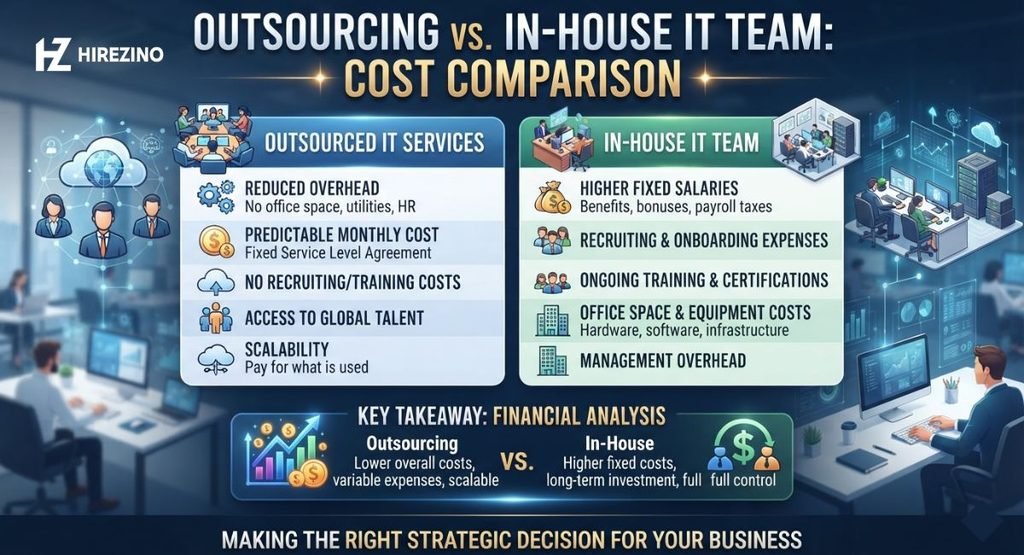
Money talks. Let’s head to the real numbers. The cost of an in-house IT specialist in the United States is $75,000 to $95,000 per annum, which includes salary and benefits. Install training, software and hardware, and your total cost of ownership skyrockets. This is where Outsourcing vs. comes in. In-House IT Team is interesting to small business owners.
Outsourcing typically has low initial costs. The price of many managed service provider plans is between $100 and $200 per user per month. That is a cost of a variable rather than a salary. This enables increased cost efficiency for expanding teams. You don’t waste on idle time which means a higher ROI. However, having an in-house hire can be beneficial in the long run if your IT requirements are extensive and frequent. This is the essence of the money issue within Outsourcing vs. In-House IT Team: predictable expenses vs a larger team that you own the entire cost of.
| Cost Factor | In-House IT | Outsourced IT |
| Average yearly cost | $75,000–$95,000+ | $1,200–$2,400 per user/year |
| Cost type | Fixed salary | Fixed monthly cost |
| Hiring time | 2–3 months | Days |
| Idle time cost | Yes | No |
In-House vs. Outsourced IT: Side-by-Side Comparison Table
Occasionally, a table is the best way to say it. This section of Outsourcing vs. In-House IT Team puts both models next to each other. It serves as a quick reference cheat sheet when making the final call.
Pay attention to rows such as response time, compliance and disaster recovery. In regulated businesses such as healthcare and finance, these will often be the determining factor. Flexibility and cost are more important for general businesses. Either way, this comparison table makes the Outsourcing vs. Making decisions for the In-House IT Team, is a lot easier to visualize instantly.
| Factor | In-House IT | Outsourced IT |
| Control | High | Moderate |
| Cost structure | Fixed salary | Variable cost |
| Response time | Fast on-site | Fast remote, SLA-based |
| Scalability | Slow | High |
| Cybersecurity depth | Limited to hires | Wide expert access |
| Compliance support | Internal knowledge | Provider expertise |
| Best for | Complex, core IT products | Startups, SMBs, lean teams |
The Costly Mistake: Why Most Businesses Choose the Wrong Model
Here’s the truth. Many businesses lose money because they never study Outsourcing vs. In-House IT Team properly. They copy what a competitor did. Or they hire fast without a plan. This is the costly mistake we warned about in the title.
The real mistake is ignoring your own workload predictability. A steady, heavy workload favors in-house. A seasonal and spiky workload is a good reason for outsourcing. Businesses which choose not to do this end up paying too much for an underutilized in-house hire, or too little for outsourced staff that is unable to grow quickly enough. Getting Outsourcing vs. Having an In-House IT Team wrong can also negatively impact business continuity when experiencing an outage. Take time. Study your workload. Study your risk. Don’t guess.
Hybrid IT Model: How to Combine In-House and Outsourced IT
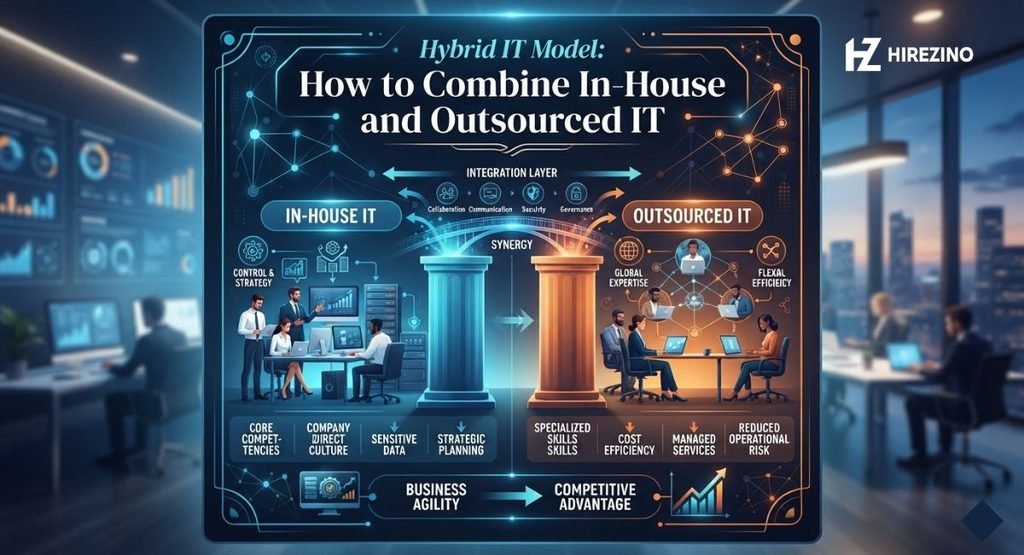
You don’t have to pick just one side. Many US companies now use a hybrid IT model. This mixes the best of both. It’s becoming the smart answer to Outsourcing vs. In-House IT Team for growing businesses.
In a hybrid setup, you keep a small in-house team for strategy and daily support. You outsource help desk, network monitoring, and cybersecurity to an outside expert. This gives you control where it matters most, plus cost savings and scalability everywhere else. The Outsourcing vs. In-House IT Team hybrid model is now the top pick for mid-size companies across the US. It reduces risk while keeping budgets in check.
How to Decide: In-House or Outsourced IT for Your Business
Ready to decide? Ask yourself four simple questions. This turns the abstract Outsourcing vs. In-House IT Team debate into a real, personal answer for your business.
- Is IT core to what you sell? If yes, lean in-house.
- How sensitive is your data? High data sensitivity may need internal control.
- Is your workload steady or spiky? Steady favors in-house. Spiky favors outsourcing.
- Can you realistically staff and keep top talent? If not, an outsourced provider wins.
Answer these honestly, and your Outsourcing vs. In-House IT Team choice becomes clear. Most US small businesses land on outsourcing or a hybrid model. Larger, IT-heavy firms often keep more in-house. There’s no universal right answer, only the right answer for your business.
In-House vs. Outsourced IT by Business Size and Industry
Company size changes the answer. Startups usually can’t afford a full IT department. They pick outsourcing for cost savings and speed. This is a common pattern in the Outsourcing vs. In-House IT Team research across the US market.
As mentioned above, mid-size businesses tend to go hybrid. Compliance regulations and the sensitivity of the data can make strictures such as those found in the finance, healthcare, or software sectors compelling reasons for large enterprises to develop strong in-house teams. Industry matters too. Different law firms have different needs from, say, a retail shop. When weighing Outsourcing vs. Always remember industry rules, number of employees and growth plans of your business when hiring in-house IT staffs. For a 10-person start-up, that’s different to a 500-person company.
Conclusion
Deciding between a in-house team and an outsourced team is no small decision to make. Outsourcing vs. Your budget, security and the rate at which you can grow your business are all impacted by In-House IT Team. In-house provides control and great in-depth knowledge, but high cost of salaries and limited coverage. While outsourcing provides the benefits of cost savings, scalability, and 24/7 support, it also involves entrusting someone else with your data. There is no one correct answer. The right option will depend on your workload, your industry, the sensitivity of your data and degree of control you really need. A hybrid approach is now used by many businesses in the US that benefits from the best of both worlds, helping to balance risk and budget. Regardless, never guess. Do not make assumptions on behalf of the comparison points listed in this guide, make decisions based on actual numbers.
In the end, Outsourcing vs. In-House IT Team means that you know your business inside and out. A basic rule is that the smaller and lower budget the startup is, the more they do well with outsourcing. If you have a big company with hard compliance requirements or have a lot of something you need in your core business, it is generally better to assemble your own team. Do your homework on your work, your plans for growth, and your risk profile before you invest. A well-informed choice between Outsourcing vs. The In-House IT Team today can help save your business from thousands of dollars and countless headaches in the future. Look over the checklist in this guide, make sure your options align with your business and then pick the model that is appropriate for where your business is going next.
Explore More Career & Business Guides
Curious about other career paths? Check out our guide on how to become a surveyor to see what it takes to break into the field.
FAQs
Is outsourcing IT cheaper than hiring an in-house team?
Yes, in most cases. Outsourcing converts fixed salary costs into a predictable monthly fee, which usually costs less than hiring, training, and retaining full-time staff.
What is the main difference between in-house and outsourced IT?
An in-house team works directly for your company and gives you full control. An outsourced provider manages your IT remotely under a service agreement.
Can a small business survive with only outsourced IT?
Yes. Most small and mid-sized US businesses run entirely on outsourced IT, since it offers 24/7 support, scalability, and expert coverage without the cost of full-time staff.
Is it safe to outsource IT and cybersecurity?
Yes, if you choose a reputable managed service provider with strong data security practices, clear SLAs, and proven compliance experience.
Should large companies keep IT in-house or outsource it?
Large companies often keep core IT and compliance-heavy work in-house, while outsourcing routine tasks like help desk support and infrastructure monitoring.
What is a hybrid IT model?
A hybrid model combines both approaches. You keep a small in-house team for strategy and control, while outsourcing support, security, and overflow work.
How do I decide between in-house and outsourced IT for my business?
Base your decision on four factors: how core IT is to your product, data sensitivity, workload predictability, and your ability to hire and retain skilled staff.
Pingback: How to Conduct a Panel Interview: The Complete Guide to Stress-Free, Effective Hiring