
The job of a security officer is to protect people and property. Officers work in all types of locations including schools and hospitals. Business owners often hire security officers for their properties but may not completely understand the responsibilities of this job. Likewise, individuals seeking security work may not understand the day to day responsibilities of this job. This results in both the employer and employee having a vague understanding of the job. There are numerous responsibilities of a security officer. Officers are required to respond to incidents and emergencies and complete detailed summaries of these incidents. Security officers are required to routinely inspect and assess their work environments. A security officer that is responsive to the needs of the work environment and has the ability to complete tasks to accomplish this helps build rapport with the people they protect. Knowing the responsibilities of a security officer helps prepare the individual to be an effective security officer. This document explains these responsibilities.
This article will cover the most significant responsibilities of a security officer. In addition, it will review the training and licensure required for this profession. It will illustrate how particular responsibilities of a security officer vary with their employment in retail, healthcare, and other professional fields. The article will provide information concerning the expected growth and average salary for this occupation. It will also provide the benefits and salary for employed and contracted positions. It will also review the various obligations a business has regarding the protection of their employees and the general public. This article will provide information helpful to those individuals considering a career in this profession or those seeking the services of a contract security company.
What Is a Security Officer?
The duties of a security personnel start with one simple job. They protect people. They protect property. They protect assets. Security Officers are found in a variety of locations from stores and offices to hospitals. Some Security Officers do not wear a uniform, while others do. The rules that all Security Officers work under are called Post Orders. Post Orders vary and are location specific.
There is a difference between Security Officers and Security Guards.They are almost the same. Both perform the duties of a security personnel. Both watch for danger. Both help keep people safe. The title often depends on the company. Some firms use “guard.” Others use “officer.” The job stays the same either way. Understanding this role helps you know what to expect from any hired security personnel.
What Does a Security Personnel Do? (Core Duties Explained)
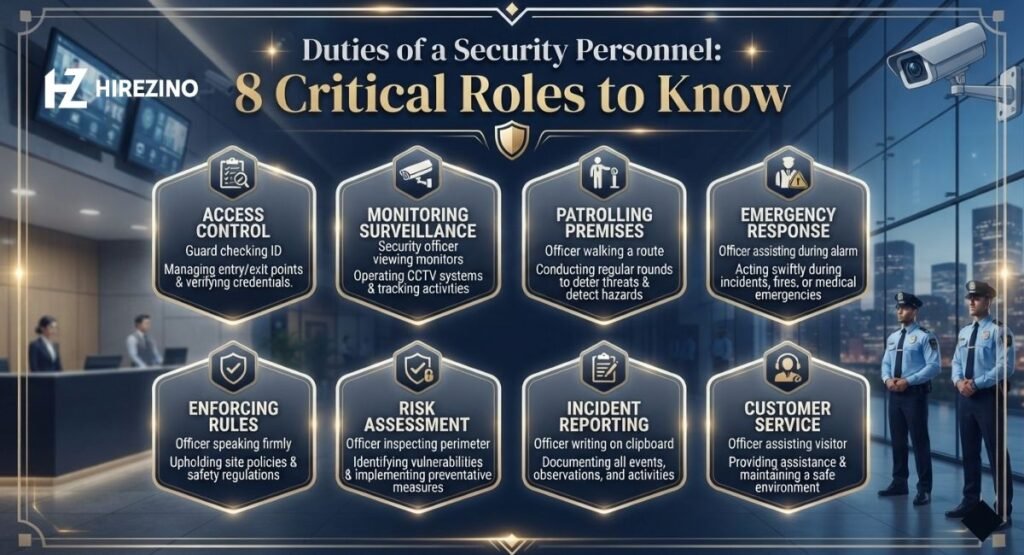
The duties of a security personnel cover many daily tasks. They patrol buildings. They check IDs. They watch CCTV monitoring screens. They stop unauthorized access. They also write reports. This job needs sharp observation skills. It also needs strong communication skills. A good officer stays alert during the full shift.
Security work changes by location. A mall guard checks bags. An office guard checks badges. A hospital guard handles patients and visitors. But the duties of a security personnel always include safety first. They respond fast during trouble. They call police when needed. They keep calm under pressure. This mix of tasks makes the duties of a security personnel both simple and demanding at the same time.
Common daily tasks include:
- Foot patrol and vehicle patrol of the property
- Access control at doors and gates
- Alarm response and emergency response
- Writing a daily activity log and incident report
- Crowd control at busy events
8 Critical Duties and Responsibilities of a Security Officer
This list covers the full duties of a security personnel in one place. Each duty plays a role in keeping a property safe. Here are some general security officer responsibilities required by most employers.
- Protection of people, property and/or Company assets.
- Initiating an emergency response to injuries and/or threats, and/or fires.
- Access control and visitor management at entry points
- Foot patrol and mobile patrol of the grounds
- Writing an incident report after every event
- Acting as a visible deterrence against crime
- Enforcing safety rules and security protocols
- Risk assessment to catch problems early
These eight points show why the duties of a security personnel matter so much. Skipping even one duty can create a safety gap. That is why training covers all eight areas. A strong officer performs the duties of a security personnel with equal care, not just the easy ones. This full list also helps property owners know what to expect from a security contract.
How Security Guard Duties Vary by Industry
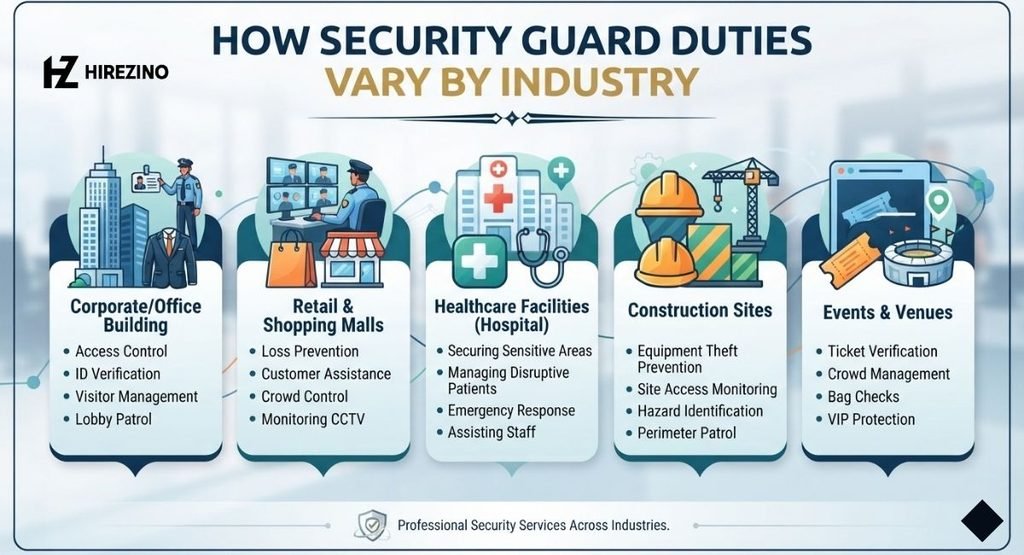
The core duties of a security personnel stay the same. But the daily work looks different by industry. An office guard focuses on access control and visitor check-in.A retail guard focuses on shoplifting and other forms of larceny. A hospital guard focuses on behavioral control of patients and the appropriate management of families and visitors. Hospital guards are often charged with the responsibility of protecting sensitive, and often confidential, information.A construction site guard protects tools and equipment overnight.
| Industry | Main Focus |
| Office Buildings | Access control, visitor management |
| Retail Stores | Loss prevention, theft, crowd control |
| Hospitals | Patient safety, de-escalation, privacy rules |
| Construction Sites | Equipment theft, night patrol |
| Schools | Student safety, access control, event coverage |
| Events | Crowd control, credential checks |
No matter the industry, the duties of a security personnel shift to fit the site. A good security company trains officers for each setting. This is why one guard may struggle at a new site without proper training. Matching the right officer to the right post matters as much as the training itself.
Key Skills Every Security Guard Needs
Strong duties of a security personnel need strong skills behind them. Skills turn training into action. The most important skill is observation skills. A guard must notice small changes fast. Next comes sound judgment. Officers must decide the right action in seconds. Communication skills matter too, since guards talk to visitors, staff, and police.
Conflict resolution and de-escalation are also key. Most problems end with calm words, not force. Customer service plays a bigger role than people expect. Guards greet visitors and answer questions daily. Physical fitness helps with long patrols. Technology proficiency helps with CCTV and alarm systems. Together, these skills support the full duties of a security personnel in real-world situations, not just on paper.
Top skills for security guards:
- Observation skills
- Sound judgment
- Communication skills
- Conflict resolution
- Customer service
- Physical fitness
- Technology proficiency
Security Guard Requirements and Qualifications
Before anyone can perform the duties of a security personnel, they need proper training. Most U.S. states require a high school diploma or equivalent. Guards must also pass a background check. Fingerprinting is common too. These steps confirm the person is safe to hire.
Training adds another layer. Most states require pre-assignment training before the first shift. Many also require on-the-job training within the first few months. CPR and first aid certification is common as well. Officers who carry a firearm need extra firearms training. These rules exist to protect both the guard and the public. Strong requirements lead to better performance of the duties of a security personnel across every site.
Basic requirements checklist:
- Age 18 or older (21 for armed roles in most states)
- High school diploma or equivalent
- Clean background check and fingerprinting
- Completed pre-assignment training
- State security license
Armed vs. Unarmed Security Guards
Not all security personnel carry weapons. Most U.S. guards are unarmed. Unarmed guards focus on observation, access control, and reporting. They rely on presence, not force. This covers most of the standard duties of a security personnel seen in offices and stores.
Armed guards work in higher-risk settings. They protect banks, jewelry stores, and other high-value sites. Armed roles require extra firearms training and stricter background check rules. The choice between armed and unarmed depends on the site’s risk level. Both roles share the same base duties of a security personnel, but armed officers carry more responsibility and more training hours.
| Type | Training Needed | Common Settings |
| Unarmed Guard | Standard state training | Offices, retail, schools |
| Armed Guard | Standard training + firearms course | Banks, high-value sites |
Security Guard Salary and Job Outlook
Pay is a common question about the duties of a security personnel.In 2025, the Bureau of Labor Statistics reported an annual wage of $38,020 for security guards in the United States. Wage differences occur between states, businesses and industries. Generally, wages in the education and healthcare fields are higher than in retail, so a career in security may provide a higher wage than a career in retail.
It is expected that the number of available positions in security will increase by about 157,200 each year. The BLS states that from 2025 to 2035, employment in security will increase by 1%.Most openings come from workers leaving the field, not new roles. This shows the duties of a security personnel remain in steady demand across the country, even as the field grows slowly overall.
Conclusion
Although a common misconception is that a person in the field of security has a very simple job, like that of a receptionist or cashier, it is important to realize that a person in the security field has many duties that include but are not limited to; patrol, access control, emergency response and risk assessment. Other duties may include but are not limited to, incident report writing and maintaining composure in stressful and/or emotional situations. While the duties of a person in a security field may vary from location to location i.e. school, hospital, retail establishment or business, the primary purpose is protecting people and property in their care. With the variation in location, the duties also may vary to some degree. In order for training to be effective, a person in the field of security must have a working knowledge of human behavior. This knowledge gives them the ability to recognize and differentiate normal from abnormal behavior. This understanding can assist in the prevention of an incident. This is the purpose of security. It is because of these reasons that the duties of a person in a security field are very important. This also explains the reason that management and ownership of an establishment take great care in selecting the right security officer.
Selecting the right security officers is critical. It impacts employees’ sense of security and their livelihood. It also impacts the bottom line. Employers should look for security officers who can perform all aspects of a security officer’s job. Before signing a contract, it also helps to know how to find operating manager contact details at the security firm you’re vetting, so you can confirm staffing, escalation, and site coverage directly. Employers should not be dismissive of an applicant just because they lack previous security experience.The security industry has consistent growth and the Bureau of Labor Statistics (BLS) projects 38,900 openings per year through 2029, despite a projected 1% growth in employment during the same time frame.Nationwide, security personnel play a critical role in preserving safety and protecting the well-being of the general public, employees and visitors in healthcare facilities and school campuses as well as shoppers in retail establishments.The role of security officer is vital. A proactive security officer protects and preserves the safety and well-being of the general public. A well-trained security officer is a first line responder and actively inhibits and reduces the opportunity for crime to occur.
FAQs
What are the main duties of a security personnel?
The main duties of a security personnel include patrol, access control, emergency response, and incident reporting. They also deter crime just by staying visible on-site.
What is the difference between a security guard and a security officer?
There is no major difference. Both titles cover the same duties of a security personnel, and the name often depends on the hiring company.
Can security personnel detain or arrest someone?
Security guards can perform a citizen’s arrest for crimes committed in their presence. Full detention rights vary by state, so limits apply.
What skills do security personnel need most?
Strong observation, sound judgment, and clear communication matter most. These skills help officers perform the duties of a security personnel safely under pressure.
Do security guards need a license in the USA?
Yes. Most U.S. states require a state license, background check, and completed pre-assignment training before a guard can start work.
What is the difference between armed and unarmed security guards?
Unarmed guards handle standard duties of a security personnel like patrol and access control. Armed guards need extra firearms training for higher-risk sites.
How much do security guards earn in the USA?
The median annual wage for security guards was $38,020 in May 2025, according to the Bureau of Labor Statistics.