

A consultant’s work isn’t just about giving advice. It takes a lot of effort to successfully run an online store in the U.S. Competition is tough. Shoppers don’t appreciate long loading times. One poorly timed business decision can be a huge waste of time and money. This is why many businesses turn to consultants for help. There are a number of things that an ecommerce project consultant is responsible for. These include planning a project, identifying the best ecommerce platform for the project, and guiding the project team to completion and launch. Also, tracking results is part of the job. Despite all this, many store owners have the same question. What exactly does this consultant do? Some people think it is marketing. Others think it is project management. Both assumptions are wrong. This article provides the true responsibilities of an ecommerce project consultant. We will cover the tasks and responsibilities and give an idea of the costs associated. You will understand how the role works and the benefits to your business.
It is also important to know what an ecommerce project consultant does. A consultant sets goals, and creates a plan to achieve those goals with a target budget and time frame. The plan includes a list of KPIs to evaluate the success of the plan. They help you refine your process to improve the conversion rate of visitors to buyers. This role will help you understand how AI chatbots and various other payment methods that will be prevalent in 2026 will help your business, as well as, how to optimize your site for business conversion. Knowing the role of an ecommerce project consultant will allow the client to determine the best time to hire, avoiding costly mistakes. This article will cover the differences between project managers and ecommerce consultants and the skills required to excel in this role. It will cover when to hire and why, as well as costs associated. You will learn how to reduce business costs, save time, and increase profit by understanding this role.
What Is an Ecommerce Project Consultant?
An ecommerce project consultant takes an online store project from idea to completion. They provide a blend of project management and business strategy expertise. They help define the scope and budget for a project and assist in the selection of a proper ecommerce platform. Generally speaking, their responsibilities stem from their client’s business goals. Many U.S. based businesses hire this type of consultant when they feel a project is too large or too risky. A consultant may be brought on during a switch from one ecommerce platform to another (i.e. Shopify vs. Magento). In general, the responsibilities of an ecommerce project consultant is advising and planning, with an extra emphasis on project management. This of course means keeping all of the project stakeholders on the same page as the development team.
This role is different from a traditional advisor. The duties of an ecommerce project consultant include hands-on assistance. They will work with you to implement changes to your website, your digital marketing and/or your business processes. The goal is always to improve your operations. This type of work can help businesses of all sizes. A consultant can help a small business (for example) to open its first online store and help a large, established business work on plans to extend its sales to multiple channels.We evaluate results, always. This is good for the client because we remove the risk out of the process as much as possible and make it as smooth as possible.
Ecommerce Project Consultant vs. Project Manager: What’s the Difference?
A project manager is responsible for the overall control of a project and also makes key decisions about the implementation of project management plans. Consultants provide expert advice on other aspects such as strategy. While there is an overlap of responsibilities with project management, a consultant’s role goes beyond that. A consultant advises on various strategic decisions related to ecommerce such as platform selection, conversion rate optimization and growth strategy, among others.
A project manager can be described as the person who keeps the work on schedule. A consultant can be seen as the person who assists in determining what the work should be. Some teams incorrectly interpret this role as a product manager. A product manager owns the product vision. That is a different job again. Knowing the split helps you avoid gaps. It also shows why the responsibilities of an ecommerce project consultant are wider than most people expect.
The following outlines major differences. Use this to see where ecommerce project consultant responsibilities overlap into other areas. Usually, some overlap is acceptable. A problem occurs when no one is formally responsible for a given task. On smaller teams, the ecommerce project consultant often covers both the advisory and delivery roles. To begin with, highlight who owns what to clarify this. The focus is often on the delivery of the outcome, and when required, advice on how to improve this.
| Role | Main Focus | Typical Deliverables |
| Ecommerce project consultant | Strategy plus delivery | Roadmap, platform recommendation, KPI plan |
| Project manager | Execution and delivery | Project charter, WBS, timeline, status reports |
| Product manager | Product vision and market fit | Product roadmap, user stories, pricing |
Key Responsibilities of an Ecommerce Project Consultant
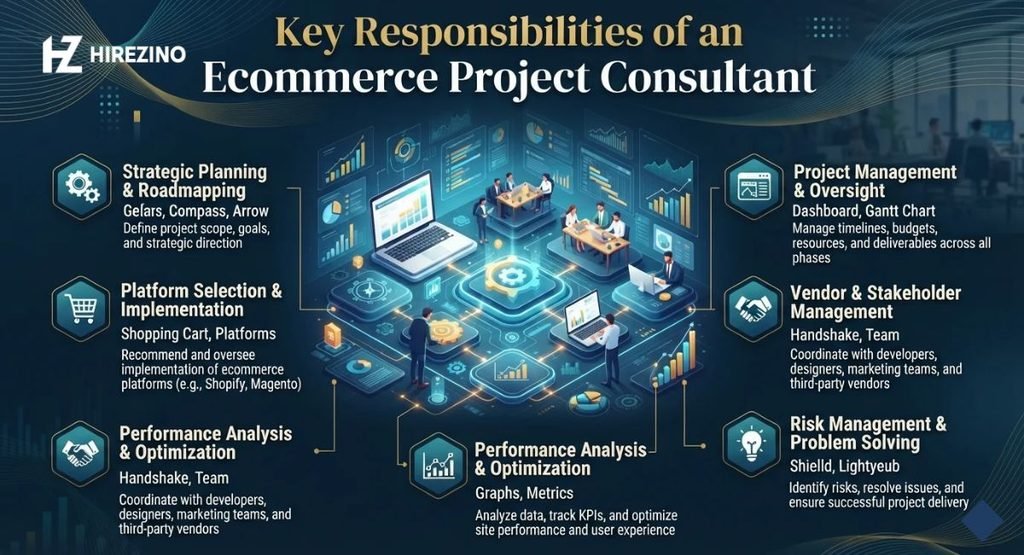
The core responsibilities of an ecommerce project consultant fall into a few groups. FIn stage 1 they audit your store. This includes speed and performance tests on mobile, as well as tests on how easy it is for users to navigate your site. In stage 2 they develop a plan, this includes establishing goals and associated Key Performance Indicators (KPIs), and setting a time frame for achieving the goals. The responsibilities of an ecommerce project consultant also include risk checks. They look for problems before those problems grow. U.S. shoppers expect fast and simple stores. As an ecommerce project consultant, you will work on many projects around user experience. An organized approach will save your company time and money and protect your brand.
Here are the main things you will be responsible for. This is what the clients expect of you:
- Evaluate web site and UX and the checkout process
- Recommend the most appropriate ecommerce platform
- Create a plan to increase conversions and A/B testing
- Design a digital marketing plan including paid and organic search (PPC and SEO) and email marketing
- Review the products and pricing strategy
- Evaluate the selected products and pricing strategy
- Set up Google Analytics and KPI dashboards
- Manage risk and change requests
Each item supports one goal. That goal is more sales with less waste. Seen together, the responsibilities of an ecommerce project consultant act like an operating system for your store. Every part must work with the others. That is why the responsibilities of an ecommerce project consultant are never just one task.
Responsibilities in Every Phase of a Project
All projects are divided into five main phases: Initiation, planning, execution, control and closure. Each of these phases brings its own challenges and responsibilities for the ecommerce consultant. During initiation, the consultant is responsible for problem identification, and scoping. They also write the project charter, and analyze the first budget and RFP. During planning, the ecommerce consultant creates the WBS and project schedule. They set KPIs, establish a change management process and define exit criteria. In addition to establishing a change management process, the definition of exit criteria helps to define the scope of the project. Exit criteria also help to alleviate the need to constantly deal with scope creep and put the project team in a reactive (fire fighting) state. This is also the responsibility of an ecommerce consultant.
During execution, it is the responsibility of the consultant to choose the project management methodology (e.g. Scrum, Waterfall, Kanban, etc). They also manage the project backlog, project schedule and budget. During control, they review and manage change. The defect resolution is done in collaboration with the QA engineers. During closure, they get sign off. The consultant also plans and arranges for post launch support. This responsibility of an ecommerce consultant aligns and supports lessons learned.
Platform Selection, Website Optimization, and Conversion Strategy
There is a focus on comparing different platforms as part of your work. As an ecommerce project consultant, you compare Shopify, WooCommerce, BigCommerce and Adobe Commerce (Magento). You analyze the product type, the size and the growth plans of the business. You assess the integrations of the business with the CRM and ERP. You analyze payment gateway integrations and assess if there is a need for a change. You plan the platform migration. If there is a migration, you ensure there is minimum impact on SEO. This is one of the most important and expensive decisions in the ecommerce space. That is why the job of an ecommerce consultant focuses on getting the fit right. Having the right ecommerce platform can reduce months of rework.
Improving conversion is the focus of the ecommerce project consultant after the platform is launched. An ecommerce consultant studies heat maps and session recordings and conduct A/B tests. Improving trust and reducing cart abandonment is the focus. Adding customer reviews and improving the checkout page and website speed is the focus. CRO can be rapid and efficient and lead to immediate improvements in conversion. Negative user experience can result in loss of potential customers. That is why, for an ecommerce consultant, the focus is improving the checkout page and the user journey to reduce friction. These improvements aid in turning visitors to buyers.
How AI and New Technologies Are Changing the Role in 2026

Artificial Intelligence is nearly ubiquitous in online stores and therefore, ecommerce consultants must be experts in AI to evaluate when, and how, it may help. Consultants now integrate AI chatbots into client’s online stores to provide basic customer service. These chatbots help clients with questions about orders and returns, as well as provide AI-suggested product recommendations and AI personalized marketing. These chatbots use The chatbots provide ideas and recommendations to customers based on customer data. AI also plays a role in fraud detection. It may help flag a transaction as potentially fraudulent due to unusual or atypical transaction behavior. The responsibilities of an ecommerce project consultant also include determining where AI does and does not help, and where AI actually creates additional work. A chatbot is not going to change a client’s return policy, it will just automate the service. A true business need, such as a return policy, for example, provides the basis for testing and implementing one of these recommended tools.
New payment methods are impacting ecommerce consulting too. More buyers are using digital wallets or BNPL (buy now pay later) services. Consultants are advising businesses on the payment methods to incorporate based on their clientele. The rise of omnichannel shopping is pushing consultants to advise businesses on how to use data to improve or tailor products to individual customers, anticipate or enhance shopping experience. GEO is new and has ecommerce consultants advising businesses on how to incorporate this to predict how their business will show up in AI generated answers. The goal is to have your business shopping ready for 2026.In each case, the responsibilities of an ecommerce project consultant include giving you an outside view.
Skills and Qualities of a Great Ecommerce Project Consultant
An ecommerce project consultant must be able to juggle several things at once. For this role, having a good base of project management skills is a must. Several consultant candidates have a PMP or Scrum Master certification. A good consultant should know project management tools like Trello and Slack. They should also know Gantt charts and have the ability to analyze data, as well as know how to use Google Analytics. They should have an understanding of ecommerce web platforms like Shopify, Magento, and WooCommerce, as well as Omni-channel platforms. For the ecommerce project consultant role, experience in various industries is essential. Ideally, they have B2B and/or B2C experience. Also, experience having coordinated a team or project across several areas of a business is a plus. The ecommerce consultant role is vast, covering parts of the marketing, technology, and operations areas of the business.
Previous results speak for themselves. Ask for case studies. A good ecommerce consultant is also honest. They will be blunt about ideas they believe to be bad.
When is Hiring an Ecommerce Project Consultant Appropriate?
Some signs show it is time to get help. The responsibilities of an ecommerce project consultant fit best when you face a clear problem. Your conversion rate may be low even with good traffic. Your ad spend may not return a profit. Your revenue may have stalled. You may plan a platform migration or a new marketplace launch. Your tech stack may feel messy and slow. Be prepared to give outside opinions in each case. As an ecommerce project consultant, you’ll give fresh eyes to a project. Potential clients hire consultants early in a project. It usually costs less to fix issues then versus after a failed product launch.
Not every project benefits from the involvement of a consultant. A small, simple change may not need one. For bigger projects, the responsibilities of an ecommerce project consultant bring real value. You get steady progress reports, lower risk, and one point of contact for changes. Your team gets less admin work. Your project stays closer to its budget and timeline. The responsibilities of an ecommerce project consultant also lower the chance of scope creep. Establish goals and provide KPIs and budget before hiring. Then ask how they will address those parts of the plan.
How much does an ecommerce project consultant cost?
Location, scope, skill and impact cost are factors that determine price. The responsibilities of an ecommerce project consultant are generally billed hourly, on a project basis or retainer. There are older industry sources that show U.S. rates of mid-level help to be approximately $30 an hour. Expert rates are approximately $50 to $200 an hour. Keep in mind, these rates are approximate, so request current rates. The price is generally determined by the scope of the project. An audit project of a store is likely to cost less than a project to replat form a store. Freelancers in other countries may charge’ less, but a consultant in your time zone may help you move through project tasks faster. Remote consultants also need clear communication, so good remote work etiquette helps keep the project on track. Consider the full responsibilities of an ecommerce project consultant when shopping for services, not just the price.
You should consider expected results over costs when shopping for services. Let’s say there is a store that makes $10,000 a month. If that store’s consultant is able to get a 10% increase in sales, the store consultant would have been worth $1,000 a month. A consultant would be worth more to a store that makes $150,000 a month. Choose a consultant that is knowledgeable about the platforms you need, has case studies and gets good results. Don’t pick a consultant just because they charge the least. Consider the scope of work. A clear scope, the responsibilities of an ecommerce project consultant should be in your contract.
Conclusion
An ecommerce project consultant’s duties include planning the project and selecting the most suitable ecommerce platform. A consultant has the duty of setting clear Key Performance Indicators (KPIs) for the project. They are involved throughout the entire project cycle including improving the checkout process and analyzing conversion rates and ROI. In the future, a consultant will help you leverage AI chatbots and GEO targeting to improve your online store’s checkout process. A consultant has a unique advantage of controlling almost every aspect of an online store’s checkout process. This usually occurs before the Store’s staff becomes aware of any issues. For U.S. businesses who seek gradual growth and want to control their budgets and timelines, a consultant is the right choice. Today’s strong plan means addressing potential issues that may occur tomorrow. It also gives your team one clear point of contact. This role makes it easier for you to define and set goals.
You’ve learned the skills. Now it’s time to put them to the test. Begin by outlining your largest problems. Are your sales stagnant? Is your checkout taking too long? Are you planning a platform migration? Once you have your problems documented, consider the responsibilities of an ecommerce project consultant, and identify the expert that has the right case studies, platform and communication skills. Ask for their process and scope of work. Compare full responsibilities of a consultant, and not just their hourly rate. The right partner will assist in communicating risk, and keeping project stakeholders informed. Bring in help before a project fails. A failed launch will cause the most stress and burn the biggest hole in your budget. Book your project consultation to get a clear path for your next big project.
FAQ’s
What are the typical duties and responsibilities of a project consultant?
A project consultant assesses client needs, plans the project scope, budget, and timeline, and advises on the best strategy. They also guide delivery, track KPIs, manage risks, and report progress to stakeholders. The responsibilities of an ecommerce project consultant add platform selection and conversion optimization.
What are the 5 C’s of e-commerce?
The 5 C’s are Customer, Company, Competitors, Collaborators, and Context. Online businesses use this framework to analyze their market and plan strategy.
What are the 7 C’s of e-commerce?
The 7 C’s are Context, Content, Community, Customization, Communication, Connection, and Commerce. They describe the key parts of a website’s customer experience.
What are the 7 C’s of consulting?
There is no single official list. Commonly cited versions include Clarity, Credibility, Communication, Collaboration, Competence, Commitment, and Consistency. Always check which version a source uses.
What are the five key traits of successful consultants?
Successful consultants share five traits: analytical thinking, clear communication, adaptability, credibility, and strong problem-solving skills. These traits help them earn client trust and deliver results.
What is the golden rule of consulting?
The most common version is to always put the client’s best interests first. Many consultants also say “never surprise the client,” which means keeping them informed at every step.
What is the 80/20 rule at McKinsey?
It is the Pareto principle: about 80% of results come from 20% of the effort. McKinsey consultants use it to focus on the few issues that matter most and avoid chasing perfection.
What is the rule of 3 in consulting?
The rule of 3 means grouping ideas into sets of three, such as three key points or three recommendations. This keeps messages clear, simple, and easy for clients to remember.