
What is an EVP? 1. It is the commitment a firm makes to its employees. .It’s a mirror of what people do for their skills and work. This includes income, perks, growth, and a nice work environment. Hiring is hard right now in the US. Workers have many of options, so firms need a strong reason for them to come and remain. A strong EVP helps you differentiate yourself. Gartner estimates it can cut annual turnover by 69 percent.
So what is an EVP made of? It’s centered around a handful of major EVP pillars: compensation, benefits, career development, corporate culture and purpose. They combine to make the whole employee experience. In this guide you will discover What is an EVP in simple terms. You will also learn how this varies from employer branding, how to construct one, and how to distribute it. At the end you can make a promise that really attracts great talent.
What Is an EVP (Employee Value Proposition)?
What is EVP? It’s the employee value proposition a firm puts out to its personnel. It is all they receive for their skills and work That means income, benefits, growth and a fantastic place to work. Many US companies use it to find the top personnel . A clear EVP says why someone should join your team and why they should stay. This also helps you stand out from other employers. Powerful and simple.
Some individuals see what is an EVP. And find ghost stories. That’s a different EVP. EVP stands for Electronic Voice Phenomenon. EVP always means employer value proposition or employee value proposition here. If you know what an EVP is, you can see why job applicants take their time comparing offers. They want more than just money. They desire work/life balance, company values, meaning. Your EVP captures all of that in one clear message. Short and simple and honest.
Why Is an EVP Important for Attracting and Retaining Talent?
What is an EVP you may ask? It’s good for your bottom line. Strong EVP attracts and retains the top talent. Gartner says it may cut annual attrition by 69%. LinkedIn says an excellent employer brand attracts 50% more qualified applicants. The right people are applying. The wrong fit is thrown away. This saves time and cost. That is particularly the case in a tight U.S. job market. Gallup: Half of U.S. workers willing to resign
A weak EVP has a serious cost As hiring slows, leaders will often ask, “What is an EVP?” Often the answer is broken promise. High turnover of personnel results in increased expenses of recruitment and bad morale. A strong EVP also enhances employee engagement.“Engaged employees can be up to 21% more productive,” according to Universum. Leaders who know what an EVP is can fix those gaps early. It’s something you become over time. And every team wants that.
Employee Value Proposition vs. Employer Value Proposition: What’s the Difference?
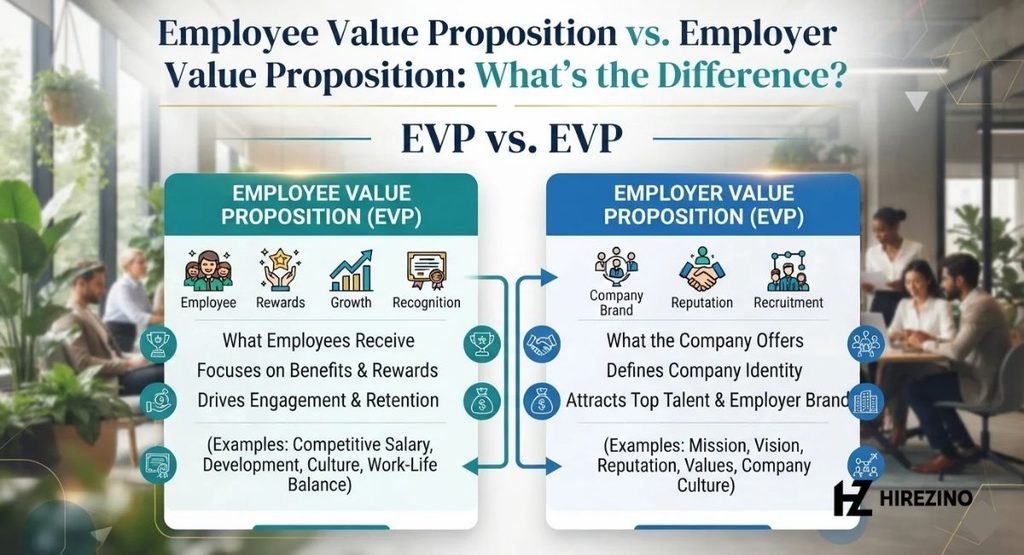
Many persons often misunderstand these concepts. When we inquire what is an EVP both variations show up. What workers get is the employee value proposition. It’s about pay & benefits, growth, culture and work life balance. It looks inside. The employer value proposition is outward looking. It’s how the corporation wants the market to view it. So what’s an EVP outer level? It’s your open promise to prospective hires.
The two ideas coexist. A strong employer promise is grounded on a real employee pledge. If personnel don’t feel it, the public message will sound hollow. Candidates browse Glassdoor and ask their friends. They identify gaps quickly. Greenhouse reported 45% of candidates declined a post after feeling deceived. Start from the inside. Fix what is broken. Then tell the tale. And that’s the key to what is an EVP done well. Honesty from the start fosters trust.
| Employee Value Proposition | Employer Value Proposition | |
| Focus | What staff receive | How the company appears |
| Audience | Current employees | Candidates and the market |
| Main goal | Retention | Talent attraction |
The 7 Essential Pillars of a Strong EVP
Now let us see what is a EVP made of. Experts call the parts EVP pillars. Each pillar meets a different need. Some cover money. Others cover meaning and belonging.Here are seven pillars that support most US employers:
- Fair pay and bonuses: competitive salary and compensation
- Benefits & advantages paid time off, health, retirement
- Career development and growth: training and clear pathways
- The positive work environment is one that is flexible, inclusive and safe.
- Trust and collaboration, a strong working culture
- Reward and recognition: applause for each win
- Our Company Values & Mission: A Cause To Believe In
You can’t pay your way out of a poisonous team. Great culture doesn’t make up for unequal compensation. For a real pay example, see the Bloomberg software engineer salary. So rank the pillars in order of what matters most to your people. So rank the pillars in order of what matters most to your people. Gen Z might seek flexibility. Older workers may desire steadiness. Knowing what is an EVP for each group assists in its tailoring. So what is an EVP at a tiny company? It can be a close team, and a real say.
EVP vs. Employer Branding: What’s the Difference?
People usually confuse the two. Knowing what an EVP is helps you perceive the line. Your employer brand is what people perceive of you as a place to work. “It can be really good, it can be bad or neutral.” Your EVP is what you wish to be seen as. Employer branding is how you express it. So in this picture, what is an EVP? It is the basis. The brand develops from it.
Imagine a house. The EVP is the basis. Employer branding is the paint. The front door. Employer branding provides consistency at every touchpoint. No paint will assist if the basis is weak. Teams that realize what is an EVP repair the real experience first. “Then they put it on the careers page and LinkedIn. That order saves your reputation. Here’s a way to look at it: EVP is the promise, branding is the promotion and the brand is your reputation.
How to Create an Effective EVP, Step by Step

Now you know what is a EVP. Let us build one. Most firms need three to six months, says Flexa. Step one: audit what you offer today. Step two: ask your people. Use surveys, focus groups, and stay interviews. Include staff from every level. Also talk to former staff. Their views show real gaps. Knowing what is a EVP in your own firm starts with these voices. Look for patterns. Those patterns are your raw material.
Step three: benchmark against competitors. Find gaps you can fill. Step four: define your EVP pillars and write a short statement. Keep it true, clear, and different. What is a EVP statement? It is one or two lines that sum up your promise. Step five: test it with leaders and staff, then launch. Get leadership buy-in early. Gartner says top firms spend about 80% of effort delivering it. Review your EVP once a year.
Great EVPs from market leaders
Now, with concrete instances, everything is evident. Now let’s watch an EVP in practice. You may find HubSpot’s mission and Culture Code on its careers page . Airbnb ties its perks to its purpose It provides credits for volunteer service and travel. Spotify offers six months of paid parental leave . What an EVP looks like at its best is shown by each company: a real promise with real execution. They don’t only run on salary.
Salesforce’s culture and social impact are well-known. Patagonia’s EVP emphasizes sustainability. It draws workers who want to make a difference. One example is a US tech firm statement: “Grow fast, work your way and build products people love.” It’s short and to the point. Test your own personnel first. Remember EVP: Always what is a promise you can deliver. Don’t fake a large brand. Use your own facts .
How to Measure the Effectiveness of Your EVP
How to Measure the Success of Your Employee Value Proposition
You can’t improve what you don’t measure. Anyone asking what is an EVP must also question how can you quantify it . Figures: Employee engagement rate, r etention rate, turnover rate, productivity Provide hiring metrics (time to fill, quality of applications, etc) If engagement is up and turnover is reduced, your promise is on track. “There’s not one ‘EVP score,’” says Gartner. So look for lots of signals. Measure frequently, not yearly.And don’t ignore the more subtle indications.” • Employee surveys and retention interviews. Check out what coworkers say on Glassdoor and social media. They’re a reflection of the way your employer brand is viewed. If what you’re saying doesn’t match the reviews, that’s a red flag. Compare Prices If you are still doubting the value of an EVP. Lower cost to recruit them. Less people leaving. Once you see what an EVP can do for you in terms of data, you’ll be lobbying for it at every budget meeting.” New person? Ask them why they said yes.
How to Communicate Your EVP Internally and Externally
A great EVP is worthless if no one hears it. Many leaders learn what an EVP is, but forget to tell it. Begin on the inside. Put it in onboarding, team meetings and intranet. Let the senior leaders say it … out loud … Testimonials & Stories from our Employees It is internal communication. It keeps the commitment alive. Ask every single employee at your organization what an EVP is and they should give you the exact same clear crystal explanation. The aim is consistency.
Then go out. This is beyond communication. Share your EVP on LinkedIn, job adverts and careers page Use Authentic Staff in Your Photos & Videos. A candidate should be able to easily understand what EVP is in layman terms. Maintain consistentMessaging across all mediums. Gen Z applicants: Emphasize flexibility, purpose and learning. The 2026 EVP will be custom-made and will help mental wellness. Remember your pledge, and listen.
Conclusion
What does EVP stand for? Ultimately It’s a guarantee the corporation makes to its employees. It covers pay, bonuses, advancement, culture and mission of the firm. US jobs market… “Employees are considering their options closely” A hazy message will not fool them. And a good and real one will. A strong EVP helps you retain your finest employees and recruit top talent. It also reduces attrition and hiring costs. Gartner says it can cut its turnover by 69 percent.
So now you know what an EVP is, and why it is significant. The first thing to do is to find out what matters most about your staff. Short statement. Post it on job boards and your careers page Most of all, honor your word. Monitor staff engagement and retention, and assess your EVP every year. If you’re still not convinced of the genuine value of an EVP, have a look at the results. Smarter apps, lower turnover.
FAQ’s
What does EVP mean in a job title?
EVP in a job title is for Executive Vise President. It’s a senior leadership position that generally reports just below the C-suite or president, and oversees a large division or function.
What is an EVP in a company?
In a company, EVP might stand for Executive Vise President, a top executive who manages a major business unit. In HR it’s Employee Value Proposition, the promise of compensation, benefits, growth and culture a firm makes to its employees.
What is an EVP in ghost hunting?
EVP: Electronic Voice Phenomenon in ghost hunting. These are sounds on audio recordings that some believe are voices from spirits. Skeptics believe they are mainly just background noise or the brain trying to identify words in random sounds.
What is an EVP salary?
EVP compensation varies widely by industry and size of company. According to Payscale, the typical base salary for an Executive Vise President in sales and marketing is approximately $187,000, however the incentives and equity can increase the overall remuneration significantly for large firms.
What jobs pay $500,000 a year in the US?
Jobs that usually pay $500,000 in total compensation annually include CEOs and other C-suite executives, senior executives at large companies, investment bankers, law firm partners and top medical specialists, such surgeons. Many of these payments are not in base salary, but in bonuses, stock or profit sharing.
Who is higher, COO or EVP?
A COO is normally above an EVP, as the COO is a C-suite officer and often manages the EVPs. Titles are different by company so some EVPs at big companies have greater power than a COO at a smaller company.
What is the typical salary for a COO at a $100 million company?
A salary guide shows that the median base wage for a firm with revenues between $100 million and $500 million is around $225,000, with total compensation between $350,000 and $700,000. Survey of PE owned HVAC companies (revenues $100MM+). Median base: $305K COO