
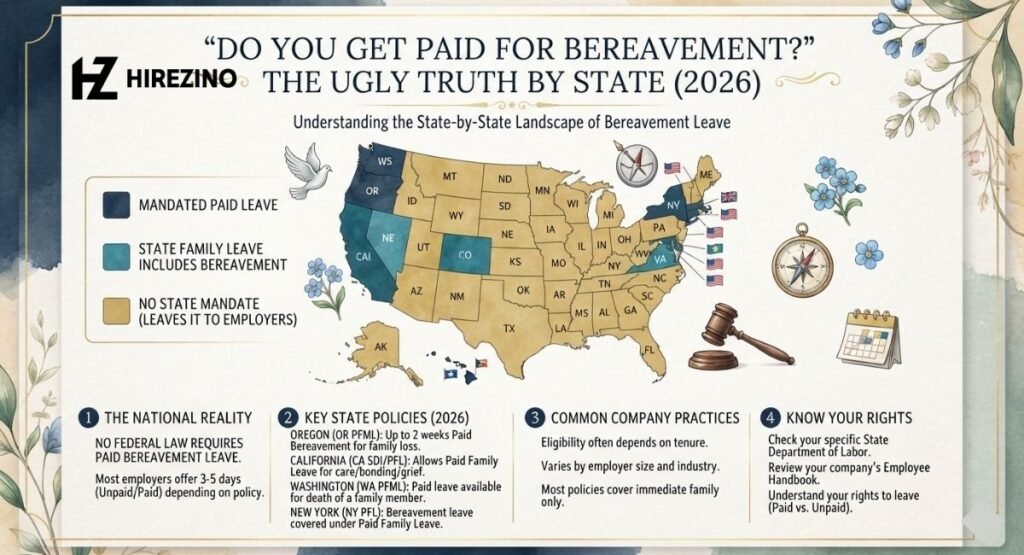
Are you paid for taking time off from work after a loved one dies? In most cases, federal law does not mandate that a private employer offer paid days of leave to employees for a death. Others may provide PTO or vacation time, or have a policy of paid bereavement leave. Protections of the state laws can also be varied. Thus, whether you are paid for bereavement leaves is based on your place of employment, take the leave rules of your employer, and the nature of the leave.
To avoid being blindsided by bereavement leave, you and your HR team need to understand what it’s all about. Protected does not necessarily mean paid—some states offer leave, but not all states. Your company may also have regulations regarding immediate family, paid days and/or documentation. In this guide, we’re going to talk about bereavement pay, what the law says in 2026 by state, how many days you can take, and what your options are if your employer doesn’t pay you for your bereavement.
Is Bereavement Leave Paid or Unpaid? The Short Answer
So, do you get paid for bereavement? Usually, not automatically. There is no nationwide requirement for private employers to provide paid bereavement leave. Your employer may offer paid bereavement leave as a company benefit. Your workplace may also let you use PTO, vacation, or another type of accrued paid leave. The exact answer depends on your employer policy and applicable state law.
When asking do you get paid for bereavement, separate two questions. First, can you take time off after a death? Second, will that time be paid? Those are not always the same. A state may protect your right to take bereavement leave but not require your employer to pay you. Illinois, for example, provides eligible employees with up to 10 workdays of unpaid, job-protected family bereavement leave. Employees may substitute available paid leave.
Is There a Federal Law That Requires Paid Bereavement Leave?
Under federal law, the answer to the question of whether you are paid for bereavement when employees ask is typically no. Employers are not obligated to pay time not worked under FLSA. The U.S. Department of Labor specifically says that the FLSA does not require payment for time spent attending a funeral.
FMLA is also not a general paid benefit of bereavement. It offers up to 12 weeks of unpaid, job-protected leave to certain qualified workers for certain family and medical reasons. The normal loss of a loved one does not qualify as a standard FMLA qualifying reason. FMLA leave itself may sometimes be used by the employee by utilizing available paid leave. If you ask, is the federal law that pays you for bereavement, the answer is NO. Your employer may have some rights that are not included above, or your state may have other rights.
States That Legally Require Paid Bereavement Leave in 2026
When inquiring with state about bereavement, just be cautious about the word “paid. Others states may allow you leave due to bereavement, but are not obligated to pay you for the bereavement leave. Other laws allow workers to take accrued paid leave. A few public-sector systems have separate paid benefits. This does not imply that if there is a bereavement law in place in a state, then all workers will receive individual bereavement payments.
The rules vary from state to state, as seen with California, Illinois, Oregon, Maryland and Vermont. While most employable workers in California who are covered by the law are eligible for up to 5 days of bereavement leave, the law does not automatically make the 5 days a benefit for the employer. Illinois offers up to 10 workdays of bereavement leave, which could be replaced with paid leave. Under OFLA, Oregon grants bereavement leave, which is unpaid (excluding the possibility of another paid-leave benefit).
| State | Bereavement protection | Automatically paid? | Important point |
| California | Yes | Not generally | Up to 5 days for eligible employees |
| Illinois | Yes | No | Up to 10 workdays; paid leave may be substituted |
| Oregon | Yes | No | OFLA bereavement leave is unpaid unless another paid benefit applies |
| Vermont | Yes | No | Up to 2 weeks may be used as bereavement leave; accrued paid leave can be used |
| Maryland | Paid leave may be used | Not a separate universal bereavement wage benefit | Certain employees may use earned paid leave for bereavement |
Maryland is an example that is useful. The Flexible Leave Act provides covered employers bereavement leave with pay to employees who have suffered the loss of a family member. Leave with pay is defined as earned sick leave, vacation and compensatory time. The statutory leave provisions under the family leave provisions of Vermont law are limited to bereavement leave of up to two weeks, but leave is not paid; the employee may use any accrued sick, vacation or other paid leave. So, what is the law and what benefits are you entitled to, will have a big impact on whether or not you receive a bereavement payment.
How Many Days of Paid Bereavement Leave Can You Expect?
So, do you get paid for bereavement for three days, five days, or more? There is no single national number. Many employers create their own bereavement leave policy. The number of paid days can depend on the employer, employee classification, length of service, and relationship to the person who died. Some companies offer a few paid days. Others offer more. Some offer no separate paid benefit.
When deciding do you get paid for bereavement, look beyond the number of days. Check whether weekends count. Ask whether the days must be consecutive. Find out how soon the leave must be used. Check whether unused PTO can be added. Also check whether the company treats an immediate family member differently from an extended relative. State law can provide additional protections. For example, Illinois provides eligible employees with up to 10 workdays of unpaid bereavement leave, while California provides up to five days of statutory bereavement leave for covered eligible employees.
Who Counts as “Immediate Family” for Paid Bereavement Leave?
As with asking do you get paid for bereavement, you also have to ask the question of who is an immediate family member. Your employer may pay for a spouse, relative, child or parent. It can also be for a grandparent, grandchild, parent-in-law, step-parent, step-child or domestic partner. The definition may vary from employer to employer; state law may have its own definition.
So, the answer of “do you get paid for bereavement” may vary depending on the family relationship. Definitions of immediate family vary by state, with Maryland using child, spouse or parent. Illinois has a wider definition, which means a child, stepchild, spouse, domestic partner, sibling, parent, in-law, grandchild, grandparent or stepparent. The bereavement law in California applies to relationships with a spouse, domestic partner, child, parent, sibling, grandparent, and grandchild, as well as parent-in-law.
What Happens If Your Employer Doesn’t Offer Paid Bereavement Leave?
Do not assume that you have no options if your employer says to you do you get paid for bereavement, and says no.If your employer says no to you, do not assume that you have no options. Read through the employee handbook first. Your employer may grant you PTO, vacation, personal leave or another paid leave. Your state also may provide protected leave, or you may use earned paid leave. Generally, the Federal government does not mandate that private employers pay for the attendance at a funeral.
If your response to do you get paid for bereavement is still no, you should ask HR about the unpaid/paid options for doing so. Request any specific state rights, changes in the schedule or earned paid time. For instance, in Illinois, employees who are eligible for the Family Bereavement Leave Act can use paid leave (if it exists) instead of the statutory leave. Employees are also eligible to take paid bereavement leave that includes their accrued sick or vacation leave or any other paid leave under Vermont law. Have a written record of your request and your employer’s response. Employers and HR teams also need to understand how to manage different hiring situations. Learn how to conduct a panel interview to create a more organized and consistent hiring process.
Bereavement Leave vs. Compassionate Leave: Is the Pay Different?
People searching for do you get paid for bereavement leave will usually run into the word compassionate leave. Employer definitions may vary, but bereavement leave is the time you take off for the death of someone you knew. Funeral leave means the time off taken to attend a funeral or memorial service.) Other employers may consider compassionate leave to mean any leave taken out of “compassion.”
Do you get paid bereavement leave or compassionate leave? There is no general answers for that. Take a close look at your employer’s bereavement policy because the actual compensation for the leave is not determined by the name of the leave. Look at how many days are offered, the pay, who can be included in your family, how much prior notification is required, how much justification is required, etc. One employer may call its compensation leave “bereavement leave.” Another may call it “compassionate leave.” A third employer may not provide any compensation, but may allow you to take paid time off. It is the compensation provided that matters, not the name of the leave.
Documentation You May Need to Get Paid for Bereavement Leave
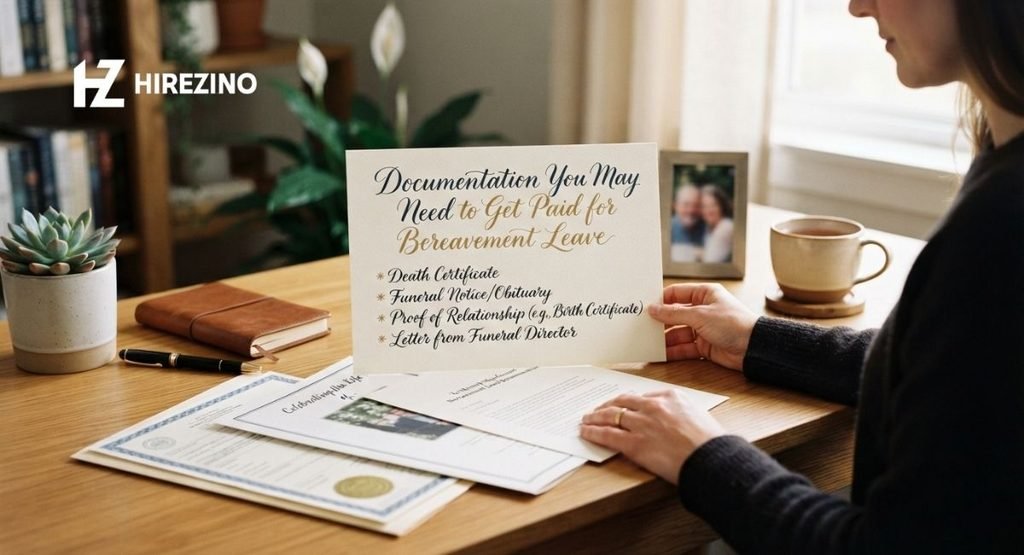
When asking do you get paid for bereavement, check whether your employer requires documentation. A company may request proof of the death under its policy. Examples include a death certificate, an obituary published by the news, funeral-home verification, and/or memorial-service details. The specific example or requirement will be based on the employer and the specific state law.
The answer to do you get paid for bereavement may also depend on whether you meet the state’s eligibility rules. Vermont law allows an employer to require documentation of the need for bereavement leave and lists documents such as a death certificate or published obituary. Illinois also allows reasonable documentation, including a death certificate or published obituary. California’s law allows an employer to request documentation within 30 days of the first day of leave. Notify your employer promptly and follow its leave request process.
The Bottom Line: Do You Get Paid for Bereavement in 2026?
So, do you get paid for bereavement? There is no simple nationwide yes or no. Federal law does not generally require private employers to provide paid bereavement leave. Your pay may instead come from an employer benefit, PTO, vacation, another earned leave bank, a state-specific rule, or a contract.
The most important question is not only do you get paid for bereavement. Ask which law and policy apply to you. Examples are death certificates, obituaries, funeral homes verifying death, and memorial service information. Some states and employers have different requirements.Research your company’s employee handbook and your state’s bereavement leave laws. Contact HR for your company’s leave policy. Learn the definition of “immediate family” for your company and the number of leave days that you are entitled to. Determine if you need to provide supportive documentation.
Losing someone is difficult enough. Knowing your workplace rights can remove at least one part of the uncertainty.
Conclusion
The issue of whether or not one is given a compensation for bereavement depends on a number of factors. Private employers do not have any general law which mandates the granting of paid bereavement leave. Others provide bereavement leave as part of their employee benefits or bereavement leave policy. Some employers will let employees use PTO, vacation or another type of accrued paid time off. State laws may also offer varying degrees of protection. Job-protected leave is available in some states after the death of a family member, but this doesn’t necessarily result in pay while on leave. Hence, the question of whether or not you’re paid for bereavement isn’t just a yes or no situation. The outcome can vary depending on your circumstances, your employer, your contract of employment and your leave benefits.
Prior to taking leave, review your employee handbook, as well as state bereavement leave laws, and check with HR regarding specific benefits. Determine the number of days that can be taken, if the leave is paid or not, who is considered to be part of immediate family, and whether or not documentation is required. It’s also worth asking if you’re able to take bereavement leave in combination with the PTO or vacation time. When you still don’t know what you’re entitled to for bereavement, these details can provide you a clear answer before you lose out on the time at work. Legislation and workplace rules are subject to change and it is always important to check the latest rules and regulations for 2026. Knowing your employee rights may help you to make the right decisions during a tough time.
FAQ’s
Do you get paid for bereavement leave?
Usually, it depends on your employer’s policy and state law. Federal law does not generally require private employers to provide paid bereavement leave.
How many days of bereavement leave do you get?
There is no federal standard. Many employers offer a set number of paid days, while some allow employees to use PTO or vacation time.
Is bereavement leave required by law in the U.S.?
Some states provide bereavement leave protections, but the rules vary. A legally protected leave period is not always paid.
Can you use PTO for bereavement leave?
Yes, some employers and state laws allow employees to use available paid time off (PTO) or vacation during bereavement. Check your company policy and state rules.
Pingback: Kay Dermatology Jobs: Proven Path to a Rewarding Aesthetician Career