

Becoming a member of a team helps employees to develop relationships, win one another’s trust and work together towards achieving the set common goal. Different work situations affect employees in a workplace negatively. Poor communication is the primary reason teams do not meet their full potential. Being a facilitator for various team building activities helps strengthen communication in a team, thus improving morale.
This manual covers the basics of team building. It gives the differences of a group and a team, the benefits of team building and activities related to team building. It provides different methods of creating team building opportunities. Some of the information in this manual are givens, but useful to enhance team building and trust. Team building is exactly what this manual covers.
What Is Team Building? Definition and Meaning
Team building is the transformation of a group of employees into a cohesive team. It uses various activities. The goal is to develop trust and work collaboration to achieve a shared objective. The U.S. Companies that have invested in team and team building have recorded an improvement in employee satisfaction and productivity. It is an ongoing process. The experts call it the glue of a high performing team.
Positive effects of team and team building encompass, improved active listening, verbal and non-verbal communication and problem solving. This is evidenced by constructive work interactions and resolution of work conflicts swiftly and with respect. A strong team feels emotionally secure to share thoughts, has them listened to, and feel valued. That is the ingredient to achieving outstanding results. When leaders encourage team and team building, a synergistic effect is achieved. In the process, the output of the team is superior to the overall output achieved by all the members of the team working separately.
Groups vs. Teams: What Is the Difference?
A group is two or more people who work together over time. One leader usually runs the group. Members often do the same job, like a retail sales staff. Team and team building starts with knowing this gap. A team is different. Each member has a unique skill, and all share a common fate. Good team and team building supports this shared success.
Teams also have shared leadership and mutual accountability. Members trust each other and follow the same mission. This is why teams often reach synergy. Leaders who understand team and team building can turn a group into a real team. Start with simple steps. Define roles and responsibilities, set shared goals, and keep communication open. Team and team building then becomes easier.
Types of Teams in the Workplace
Hackman found four categories of teams. With each category, team building and team leadership look different. An example is the Manager-Led Team, where the team relies on a leader for direction. A Self-Managing Team is responsible for planning and leading its own daily work. A Self-Designing Team determines for itself how it wants to work and is shaped by members’ initiative and leadership. A Self-Governing Team controls its own destiny and relies on itself for direction. One of the most important constraints for all of these teams is having the right level of trust and skill. The key is to know the team well enough to deploy the right kind of team building and support for the right team.
Teams also vary in other ways. Project teams are temporary while a few permanent teams work together for years. Other differences include where the team works (e.g. virtual vs. onsite) and team size. The types of team building activities also vary. For example, Project Teams need quick, yet powerful icebreakers, remote teams need process and tools to help them work, while small, permanent teams need support to stop them from falling back on old habits and ways of working. Most important for teams, is for the leader to always match the right type of team building for the needs of the team.
Teamwork vs. Team Building vs. Team Development: Key Differences
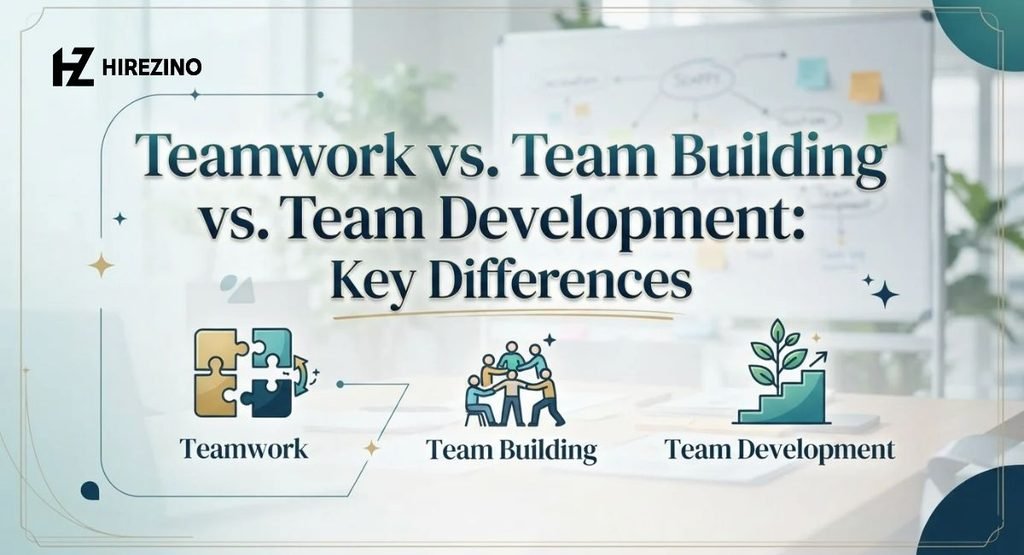
Teamwork is the act of working with others to accomplish a goal. The process of forming these bonds is what we call team building. The long and winding process of a teamworking well is what we refer to as team development. The thing is, we feel changed by both team and team building. The way we work is changed by team development. In the end, there is a gap in the knowledge of leaders who know the difference between team, team building, and team development and use them appropriately.
Use team and team building when a team is new, trust is low, or morale is down. Use team development when work habits are weak or the team faces change. The best plan mixes both. Start with team and team building to create connection. Then add ongoing coaching and feedback. This mix supports high-performing teams. The table below shows the main differences.
| Teamwork | Team Building | Team Development | |
| Focus | Doing the work together | Connection and trust | How work gets done |
| Timeframe | Daily | Short-term or ongoing | Ongoing |
| Impact | Higher productivity | Better morale | More consistent performance |
What Are the Benefits of Team Building?
Strong teams have wide spread benefits for a business. It bumps up employee engagement as people feel like they are part of something bigger. It encourages psychological safety as employees are welcomed to provide their ideas. This leads to improved employee retention as the employee quits rate goes down. Ultimately it helps reduce hiring costs. A great culture is attracted by a great product, and company. Great products and services are made by truly great teams.
There are productivity spins offs from true teams as well. True teams finishes work faster. It also improves creativity and innovation. It aids in the development of other skills of employees. It also improves other areas like decision making and collaboration. It quickly puts good in action. For all these reasons and many more, smart investment for any company is team and team building activities.
What Are the 5 Stages of Team Development?
Psychologist Bruce Tuckman described five stages of team development. Team and team building works best when leaders know the stage. First is forming. Members meet and feel unsure. Second is storming. Personalities clash and conflict appears. Third is norming. The team sets norms and builds trust. Fourth is performing. The team meets its shared goals. Fifth is adjourning. The work ends. Leaders should adjust team and team building at each stage.
The model is not perfect. Teams do not move in a straight line. Many return to an earlier stage. Some sit in two stages at once. New members can restart forming. So team and team building must be ongoing. Some conflict is healthy because it stops groupthink. Groupthink hurts decision making. Leaders should teach conflict resolution and give feedback. Team and team building is a cycle of care.
3 Essential Components of Effective Team Building
Building a good team is done through establishing trust and respect with effective communication and by being accountable.Leaders’ emotional intelligence is shown through active listening. However, trust and respect are built from leaders on the ground facilitating ground rules for deadlines and team tasks. Weekly, short meetings reinforce accountability. This ensures that this responsibility is shared.
The next element is communication. The focus for building a good team and being on a good team should be placing value on and practicing active listening, and productive and timely feedback. Being a good team member is about addressing a problem or concern by first seeking to understand the root of the problem or the concern. Looking for win-win opportunities places a shared positive focus on resolving concerns. This goal should be placing value on team members’ goals and interests. A good thing about “good team” is that the benefits show up the quickest when the focus is placed on continuous improvement, rather than on ending “good team” practices.
Types of Team Building: Natural, Internal and External Facilitation
Team and team building has three types. The first is natural facilitation. It happens through daily talks and shared work. Clear workplace rules help trust grow. The second is internal facilitation. A leader or trained employee runs team building activities like team lunches or picnics. This costs less and builds ownership. Internal team and team building feels more personal. It works well for small teams.
The third is external facilitation. A trained outsider runs workshops, icebreakers, and group brainstorming. Many U.S. firms use this type of team and team building for big goals. Remote staff need virtual team building too. Try online games or video coffee chats. Plan sessions monthly or quarterly. A few activities will not fix deep problems. Use team and team building to rebuild trust step by step.
How to Choose the Right Team Building Activities for Your Team
Choosing the right activity for your group will help you immensely with planning team building. Team demographics are any variables such as age or culture, along with things like ability. Focus on group members, and choose inclusive activities, like ways to celebrate Black History Month at work, so no one is left out. Take into consideration how big your group is. Decide on how much fun you want your activity to have, while having a clear purpose. Think about personalities as in how outgoing your group members are. Choose something that will be a challenge for your group members and something that will support them.
Some of the best and easiest ideas work the best. Try a scavenger hunt for fun, or a group puzzle to build problem solving skills. Ice breakers are good to help new groups relax. Remote groups can do a virtual trivia. Ask your group to evaluate what worked and what didn’t after each activity. Then see if employee engagement and retention improve as well as other work metrics. When working toward a goal and assessing what works and what doesn’t along the way, the goal is to improve and ultimately leave a positive impact.
Conclusion
Most people think of team building as something you do once or twice a year. In reality, it’s something that you do all of the time. It helps people at your organization work, communicate, and make decisions in a different way. In this guide, you’ve learned how to tell the difference between a group and a team, about the five stages of team development, and the importance of trust, accountability and communication. The benefits of doing this work include, but aren’t limited to, improved morale, productivity and retention. Team and team building work the best when leadership aligns it with the work being done by the people in the organization.
The time to act is now. You don’t need to overhaul your entire culture, starting small is the key to success here. Change one aspect of your work based on the feedback you get from your employees, and you’ll notice a difference in your productivity and morale in no time! That being said, don’t think that a series of fun events will solve the deep seeded problems of your organization. The key is to combine these events with a strong support system and coaching. You know the old adage, the best things in life take time, and the same can be said for the best organizations. Start today, and watch your employees thrive!
FAQ’s
What are the 5 C’s of team building?
The 5 C’s are commonly listed as communication, collaboration, commitment, cohesion, and confidence. Together they help team and team building create trust and shared goals.
What are 10 tips for improving teamwork?
Set clear goals, define roles, communicate openly, listen actively, build trust, give regular feedback, resolve conflict early, celebrate wins, encourage diverse ideas, and hold short team meetings.
Is it team building or teambuilding?
“Team building” (two words) is the standard spelling. Use “team-building” with a hyphen when it describes another word, as in “team-building activities.”
What are the four main types of team building?
The classic approaches to fixing teamwork problems are goal setting, role clarification, problem solving, and relationship building. Let’s look at each one in more detail.
What are the 5 stages of team building?
According to Bruce Tuckman, team development occurs in five stages: forming, storming, norming, performing and adjourning. Team and team building work best when the approach taken by the leader is matched to the team’s current development stage.
What is another word for team building?
Some synonyms are team bonding, group bonding, team cohesion building, and team development. Pick the term you find suitable as the term ‘team development’ means the improvement of work habits of the team members.
What is a stronger word for team?
More effective terms would be crew, unit, task force and powerhouse. “Crew” sounds more informal, and “unit” and “task force” sound more formal. “Task force” particularly suggests a group engaged in forward momentum.