

All professionals know how to politely decline a job offer at some point. Job offers come with a sense of accomplishment, but there are times when it is better to not accept. It is possible that the salary is low, an opportunity more in line with career goals came along, or the role is not even a good fit. Whatever the case is, declining a job offer helps one’s reputation and keeps a good relationship with a company for other future opportunities.
We have you covered for your declining job offer email, no bridge burning style. We have the email steps, and the email itself, ready to go. We include situations better suited for a phone call. We show how to navigate this conversation with recruiters and how to explain your reasons. Saying no to compensation offers, role offers that are just not right, and offers with bad timing are now all possible. This guide gives you the courage to say no, all while maintaining your career relationships.
Why Declining a Job Offer Politely Matters for Your Career
There are some social and professional skills that enable you to get along with people, and the ability to decline a job offer politely is one of them. Good manners help, but the real benefit you gain from politely declining a job offer is the employer’s perception of you. Relationships in the U.S. job market matter because recruiters move to different companies, remember candidates, and hire for various positions. When you politely decline a job offer, you avoid leaving a bad impression, and the next time a better job opportunity opens up on their team, the hiring manager will be more inclined to reach out to you.
Many U.S. industries, in general, are not as big as they seem to be. Recruiters of various organizations share information on the candidates they have in their database, and if you decline an offer, you are in good grace with that organization’s recruiting network and likely to be recruited again in the future.
How Many Days Before You Reject an Offer?
When it’s a matter of politely rejecting a job offer, the words and timing are equally critical. Returning an offer involves a response within 24-48 hours after you make it. If you take too long, the hiring manager may have to choose between leaving the position open or calling a candidate to fill the position as a backup. One of the most polite and clear ways to decline a job offer is to provide a prompt response. This response should not be hastily done or give the impression that you have not thought about your response. Wording is important.
You should avoid responding too quickly to an offer, and you should give yourself time to write a clear response. This response should be fully edited in order to avoid however many mistakes you would like to avoid. A response with typos will say nothing about the professionalism you have. Before you decline an offer if it is a hard no, ask for an extension. This would be a better alternative to sending a decline you wrote quickly and sloppily, although politely.
Quick timing guide:
| Situation | Recommended Response Time |
| You’re fully decided | Within 24–48 hours |
| You need more time to think | Ask for 2–3 extra days |
| Offer came late in the week | Respond by Monday |
| Verbal offer only | Confirm decision before next contact |
Step-by-Step: How to Politely Decline a Job Offer
Having a clear structure to follow when declining a job offer takes the guesswork out of the procedure when considering your words. The procedure can be adapted to either a face-to-face meeting with a hiring manager or a meeting with the help of a recruiter.
When you’re done making up your mind Avoid turning down a job offer and revoking it later. Think about the advantages and disadvantages of your approach usually an e-mail is the most appropriate way to communicate in most situations. But for senior or recruiter roles, a phone call might be a better alternative. The key point is to thank the hiring manager for the time. You need to include your decision in your message. Thats why you need to learn how to politely decline a job offer You should give a brief reason, there is no need to over-explain. Leaving yourself an open invitation for future opportunities is sensible as you should stay linked in professionally. All these steps help you to say “no” gracefully, directly and in a polite way.
When to say No to a job offer via email or phone?
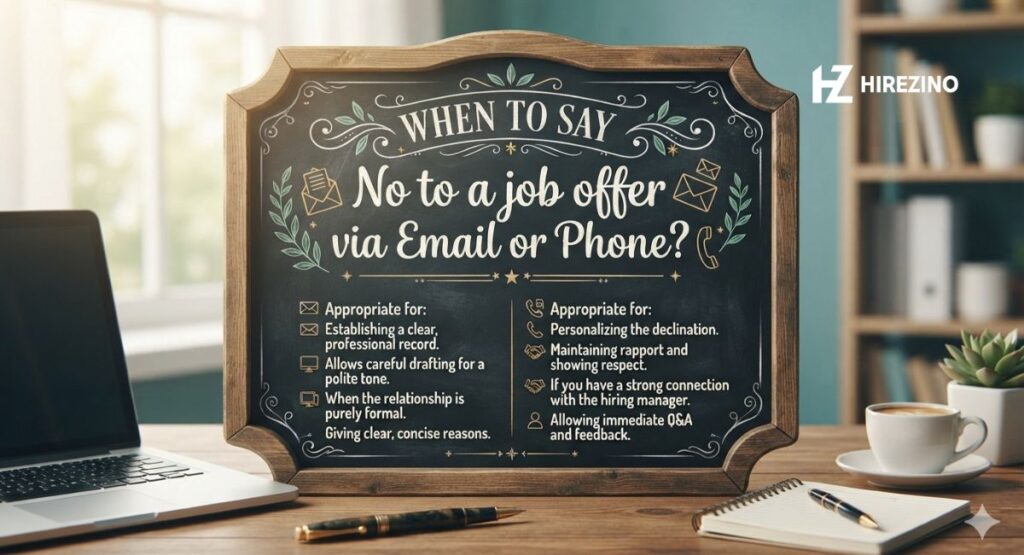
Candidates will opt for email when they politely decline an offer for a variety of reasons. It is clear, allows for processing time and is documentable for both parties. It is usually the safest default if you are early in your career or have applied to a company along the lines of digital communication during the hiring process.
There are definitely exceptions when a call would be the better option. That would be if you had developed a close relationship with the recruiter, or if the position was long-term, senior-level, and high responsibility. It is much appreciated to show extra appreciation for the recruiter-employee relationship and showing respect, and it is usually followed with a short email to confirm.
There are many methods to do this and as long as the message is professional, straight to the point, and to the point, any of the methods will carry on the same relationship.
To reject a job offer – how to write an email letter (template provided).
There are a number of items that will be common among people who receive a rejection letter for a job offer. Be sure to express thanks, give a default no thanks, include a reason if you want to (optional), and leave an opportunity open. Keep the rejection e-mail message short. The hiring manager is seeking offers which are quick. A letter of Job offer should be less than 150 words.
This is a template for the base that I will start from:
Subject: The opening line of your letter to the person you’re writing to.
To Whom It May Concern:
I appreciate your offer for the [Job Title]. I appreciate your time and the interviewing time of your staff. [Brief reason (for refusal) e.g. I have accepted a role better aligned with me] has impelled me to reject your offer.
I enjoyed hearing your team, and hope to work with your team in the future.
Best Regards,
[Your Name]
You now have a format to help you say no to the offer, whether firm or polite. This message is warm, professional, and personal with thanks.
The following are some of the most frequent reasons for rejecting a job offer and how to word them:
It’s nice to be transparent, as long as you’re being polite.It’s polite to be transparent, as long as it is nice. It’s easy to refuse a job offer. Comments should be 2 sentences or fewer.
Remuneration: “The salary was not what I had hoped for.
Role fit: “The position does not complement my skills.”
Career growth: “I am focused on positions more aligned with my growth.”
Timing: “It is not the appropriate time for me to make this career change.”
Another offer: “I have taken a position more aligned with my career goals.”
For example, a candidate reviewing an executive assistant job description might realize the day-to-day responsibilities don’t match what they’re looking for a completely valid reason to decline.
You are always able to short and politely say no to a job offer with no need to give the daunting details. A short and courteous comment is what is to be appreciated rather than the lengthy details.
How to politely decline a job offer But Keep the Door Open
The practical rejection letter guide put forward by the author of this paper applies to scenarios where one wishes to reserve opportunities for future cooperation. You may add specific cases from the interview or team interactions in the letter. This not only highlights the value of this
This not only gives a good impression of how well you will be able to handle recruiting, it also shows them that you’re interested in continuing to follow up. You can ask the recruiter to follow you on LinkedIn, assertively tell the recruiter that you would like to keep in touch, or tell the recruiter you’d like to be notified if new positions become available. The golden rule is that it is not about the words, it’s about the meaning, and the honesty.
How to Decline a Recruiter or Contract Job Offer
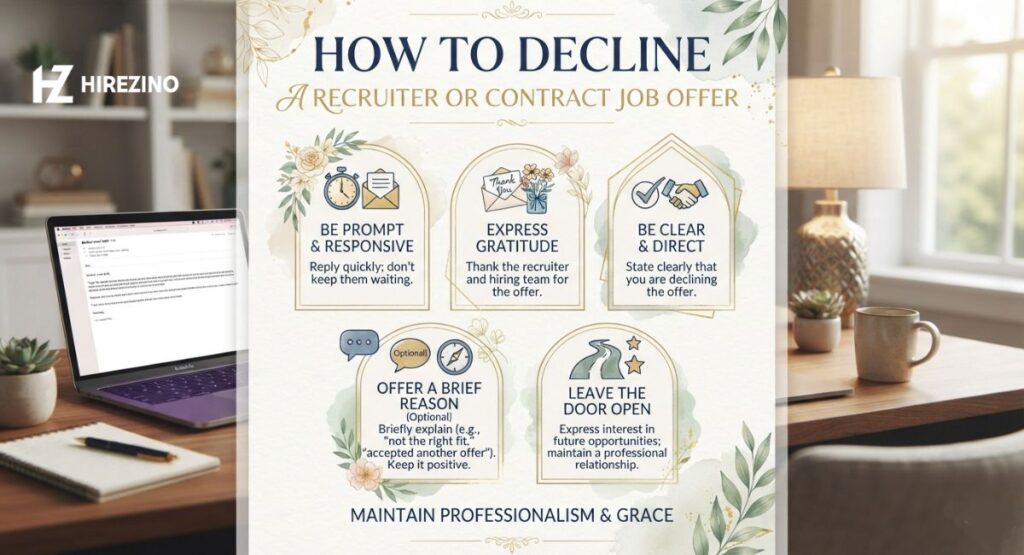
There are some differences in processes when declining a role through a staffing agency versus direct employer engagement. Recruiters usually have many jobs on their books; thus, when you politely decline and give a reason of fit, salary, or timing, you give contextual information which can help them match you to suitable roles.
While you don’t have to give personal information, being somewhat open is appreciated. Job recruiters will be much more likely to remember a candidate who offers a reason for declining the offer. Furthermore, you can improve your chances of landing better jobs and opportunities with permanent or contract employment by being honest and polite about your rejection for the right reasons and at the right time.
Do You have the right to back out of a job offer?
After accepting an offer of employment, an individual may still decline it and rescind the offer. In this case, one has to be careful. You should notify the employer as soon as you have made your choice. You will need to tell the employer the reason for your backing out and say sorry. Job seekers in the U.S. can understand why you are backing out, and as long as you are polite, this will not ruin your relationship with the employer.
You will have to tell the employer the reason for backing out. You will have to notify the employer of the reason you have backed out of the job offer. Again, this will not hurt your relationship with the employer.As long as you are polite this will not spoil the working relationship with the employer.
What NOT to do when you are being rejected for a job offer
It’s hard to turn down a job offer gracefully. The following errors should be avoided:
- Not responding at all in a polite manner
- Giving too much detail and/or personal details.
- Sending off a message with misspelled words and/or a hastily typed appearance
- Not responding in time after the final interview
- Using negative or critical language
You should be able to say no to a job offer without alienating the person or hurting your reputation in any way by avoiding these actions.
Conclusion
Well, it’s not supposed to be easy to turn down an offer, but it’s okay, it’s not easy. The most important is to be polite and reply within a reasonable time and in a few words and sincere. Whether you’re sending an e-mail, or calling or using a recruiter: Be clear, be kind and don’t leave anyone hanging.
The upside of being able to say no to an offer in a polite manner is that you won’t spend a lot of money and that the offer will benefit you in the future, perhaps in unexpected ways. The hiring manager retains a memory of a person that dealt with it well. A recruiter recalls the person that communicated well. And you leave the situation feeling good about you and never burn a bridge that you may need to cross again.
FAQs
Is it better to decline a job offer by email or phone?
For most situations, email is the safer and clearer way to decline a job offer politely. A phone call is a good option for senior roles or close recruiter relationships, followed by a short confirmation email.
How do I decline a job offer after already accepting it?
Act quickly, be honest about your change in circumstances, and keep your message short. You can still decline a job offer politely, even after acceptance, if you communicate promptly and respectfully.
What’s a good reason for declining a job offer?
Common reasons include compensation, role fit, timing, or accepting another offer. Any honest, brief explanation works when you decline a job offer politely you don’t owe a lengthy justification.
Should I explain why I’m declining in detail?
No. One clear sentence is enough. Employers expect candidates to decline a job offer politely without a long explanation.
Will declining a job offer hurt future chances with the company?
Not if it’s handled well. Candidates who decline a job offer politely and professionally are often remembered positively for future openings.