
Pay equity and pay equality are terms that are likely misunderstood by the majority of US employers. Although these two terms seem to be the same, they are actually very different.Equal pay for equal work is pay equality. Pay equity is paying work of equal value. Mixing the two up can lead to employers having an unfair pay system and potentially expensive lawsuits. Keeping rules stringent and firmly enforcing them is really the best way to ensure equality.
This document helps to ensure employees are making pay equity and pay equality, recognize the differences and similarities, and provides a practical way to conduct pay equity analysis. Legislation is covered. We provide assistance to track progress towards pay equity and pay transparency. Trust is the result of pay equity and transparency. We explain it in the most basic way to make sure you can identify and understand pay equity and pay equality and to equip you with the skills you need to keep your best employees.
What Is Pay Equality? (Equal Pay for Equal Work)
To understand pay equity vs pay equality, let’s start with pay equality. Pay equality means equal pay for equal work. People doing the same job get the same pay. Someone’s gender, race or age doesn’t change it. Pay equality fights pay discrimination. It is also easy to measure. Many people see it as the simplest part of pay equity vs pay equality.
In the US, the Equal Pay Act of 1963 backs one side of pay equity vs pay equality. It bans pay gaps based on sex for the same work. The gender pay gap shows why this still matters. Pew Research Center reported that in 2022, women earned approximately 82 cents to every dollar men earned. Pay Equality is a good start to pay equity vs. pay equality; however, it is only half of the story.
What Is Pay Equity? (Fair Pay for Work of Equal Value)
Now look at the other side of pay equity vs pay equality. Pay equity means fair pay for work of equal value. The jobs can be different. An engineer and a marketing manager may do different tasks. Yet both may add the same value to the company. So both should earn fair pay. This is the big idea in pay equity vs pay equality.
Factors like bias and workplace separation, skill and effort, responsibility, working conditions and other factors are considered by pay equity. A company, for example, may hire more women for roles that are lower paying.No laws have been broken in such cases. However, a pay gap exists. Sometimes, pay gaps are glaring, but other times, they are hidden. And, that is the reason pay equity and pay equality are inter-related and must be studied in combination. Smart employers study pay equity and pay equality in combination.
Key Differences Between Pay Equity and Pay Equality
The main gap in pay equity vs pay equality is scope. Pay equality compares people in the same job. Pay equity compares jobs of similar value. One is a legal baseline. The other is a strategic goal. Both aim for fair compensation. The table below shows pay equity vs pay equality side by side.
| Feature | Pay Equality | Pay Equity |
| Core idea | Equal pay for equal work | Fair pay for work of equal value |
| Comparison | Same job, one to one | Different jobs of similar value |
| Main focus | Legal compliance | Fairness and long-term strategy |
| Method | Direct job comparison | Pay audit and statistical analysis |
| Example | Same job, same base pay | Fair pay across job families |
Here is a simple example. Say two workers hold the same job. Pay equality says they get the same base pay. Pay equity may allow a higher salary for a worker with more experience and education. It may also allow a bigger bonus for top performance. This is the essence of pay equity vs. pay equality in real life. Knowledge of pay equity vs. pay equality by leaders makes better choices.
Why Knowing the Difference Between Pay Equity and Pay Equality Matters
It’s important for businesses to understand pay equity vs. pay equality. Pay equality offers legal protection from lawsuits and fines. It also gives you the opportunity to improve employee trust and morale by strengthening your edifice for employee pay retention.
Leaders that have pay equity/equality knowledge are better equip to plan for pay changes and communicate effectively to their employees. This knowledge also help shape and strengthen the pay conversations you have with your employees. For instance, saying that you will work to close the pay equity gap may lead some employees to believe that you only mean that you will work to close pay discrimination. To overcome this, use clear and simple language when defining pay equity/equality for your employees and trust will increase. Pay equity will increase as employees begin to understand your process for pay decisions and believe those processes to be fair. It’s a good practice to also instruct managers on pay equity/equality so that pay decisions become more strategic at all levels of the company.
Pay Equity and Pay Equality Laws Employers Must Know
US law shapes how you handle pay equity vs pay equality. The Equal Pay Act of 1963 bans pay gaps by sex for equal work. Title VII of the Civil Rights Act of 1964 bans bias based on race, color, religion, sex, and national origin. The Americans with Disabilities Act (ADA) protects workers with disabilities. Each law touches pay equity vs pay equality in its own way.
Other rules add more. The Age Discrimination in Employment Act (ADEA) covers workers age 40 and older. The Lilly Ledbetter Fair Pay Act gives workers more time to file pay discrimination claims. Over 40 states also have state equal pay laws. Many states now require pay transparency and salary range disclosure. Some ban salary history questions. Check your state rules on pay equity vs pay equality. Ask legal counsel about pay equity vs pay equality.
How to Achieve Pay Equity in Your Organization
Reaching pay equity takes a clear plan. Start with data. Collect pay data and employee demographic details. Then set clear pay bands and salary ranges for each job. Use fair, written rules for raises, bonuses, and promotions. This keeps pay equity vs pay equality in balance. It also reduces bias in daily pay decisions. Good habits make pay equity vs pay equality easier to manage.
Managers set initial salaries and recommend pay increases, so they have a great deal of influence on compensation equity. Offer training to managers on compensation equity and unconscious bias. This will help recruitment teams to review job postings to eliminate gender-based biases. Also, growing opportunities for women through sponsorship and mentorship will assist in advancing women’s careers. Be sure to hold managers accountable for pay equity issues when doing performance evaluations. Doing the same for compensation reviews sends a strong message and empowers teams to understand the differences between pay equity and pay equality. Employees will be able to make better decisions concerning their compensation. The compensation philosophy will help illustrate your emphasis on pay equity and pay equality.
What Is a Pay Equity Analysis (Pay Audit)?
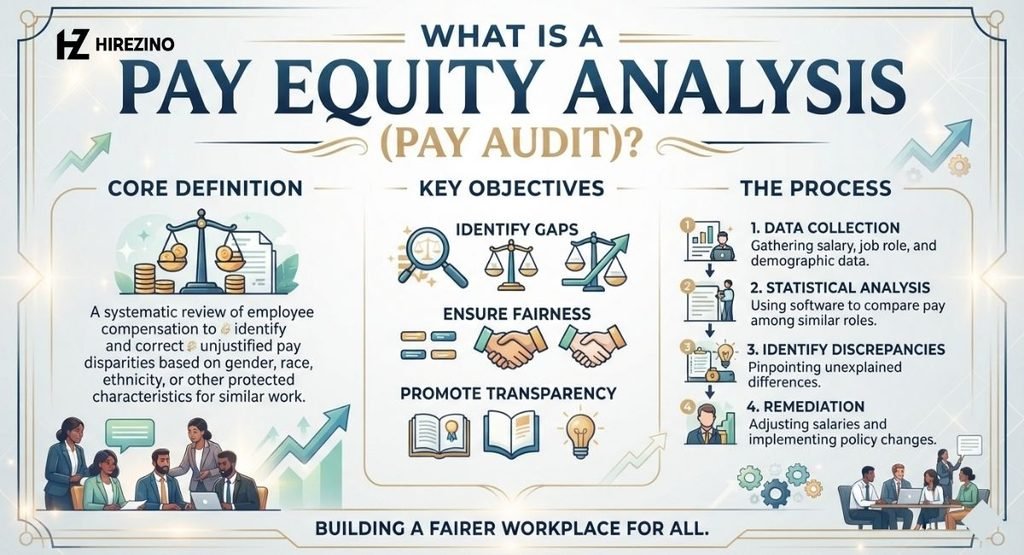
Pay equity analysis is an audit to help you identify pay gaps in your workforce. Often called a pay audit, pay equity analysis helps organizations better understand pay equity and pay equality as it pertains to their workforce. In addition to pay data, you will analyze your workforce data by factors protected under the law, job level, years of experience, job performance data, and other relevant employee data.The goal is to find gaps that have no fair reason. That is the heart of pay equity vs pay equality.
Many firms use regression analysis to do this. It helps identify legitimate pay factors from bias. Most experts in the field say that advanced statistical methods, specifically multivariate regression analysis, are needed to address this issue. You have to look for pay gaps and address them to eliminate pay gaps. Audit each year. Assess base pay and bonuses as well as equity grants. Regular audits keep pay equity vs pay equality on track. They also lower legal risk. Use them to track pay equity vs pay equality over time.
Strategies That Improve Both Pay Equality and Pay Equity
The best plan covers both sides of pay equity vs pay equality. For pay equality, audit pay often and spot outliers. Set clear salary ranges. Use fair performance review rules. Share pay info openly. These steps cut gaps between people in the same job. They also support pay transparency. Strong basics help pay equity vs pay equality work together.
For pay equity, go beyond the same-job match. Review roles that are historically underpaid. Look at promotion rates by group. Check who gets leadership roles. Widen your hiring pipeline. Remove gendered language from job posts. Support DEI efforts across the company. These moves tackle systemic barriers. Teams that master pay equity vs pay equality see stronger employee engagement. Keep working on pay equity vs pay equality every year.
How to Measure Your Pay Equity Progress
You can’t fix what you don’t measure. Be clear about goals you have regarding pay equity and pay equality and check your data frequently. Analyze the gender pay gap as well as the race pay gaps at various job levels. Track average salary increases and performance review scores. Compare them by group. Good tracking shows if pay equity vs pay equality efforts really work.
Use more key metrics too. Watch turnover, retention and mentorship stats. Look at DEI hiring metrics. Analyze pay equity vs pay equality stats each quarter/year. Provide reports to leaders and all staff. This creates and builds trust and demonstrates commitment. Use pay equity software or an HRIS tool to speed up reports. Steady tracking turns pay equity vs pay equality from a goal into a habit.
Conclusion
Pay equity and pay equality exist on the same side. Pay equality says people in the same role should get the same pay. Pay equity says roles of equivalent value should be paid fairly. Both help guard your business against lawsuits, and promote an environment of trust with your employees. Working to build a pay equity and pay equality culture at your business not only protects your business from unnecessary risk, it also benefits your employees, because valued employees are loyal employees.
Now it’s your turn. Examine your current pay data, conduct a regular pay audit and be proactive in closing any gaps you find. Make your pay policies easy to understand, and develop your managers to educate them on why pay transparency is important. Pay equity and pay equality aren’t opposing values, and the earlier you embrace both, the more loyal employees you’ll retain, and the easier it will be to attract top talent. There’s no time like the present to make fair pay a foundation of your business.
FAQ’s
Can you give me an example of pay equity?
While nurses and trained technicians perform different jobs, both are of equal value. Equity, in this situation, means both are compensated equitably based on skill, effort and responsibility.
Which one is better, equity or equality?
Pay equality and pay equity are intrinsically linked. Pay equity is the greater concept encompassing pay equality.
Is the pay gap still a thing?
Yes, women working in the U.S. still earn about 82 to 84 cents for every dollar men earn, according to the year and source of the data.
Is equal pay worth it?
Yes. Fair pay reduces the risk of legal issues, increases employee retention, and helps in attracting the best employees.
Why does the Equal Pay Act not work?
It only covers jobs that are the same or very similar, and employers can still defend gaps with “any factor other than sex.” It also does little about pay secrecy or women being placed in lower-paying roles.
What are the four exceptions to the Equal Pay Act?
Employers can pay differently based on a seniority system, a merit system, or a system that measures earnings by quantity or quality of production. The fourth exception is any factor other than sex.