

When a new airplane must travel further, faster and safer than ever constructed, what does the aerospace engineer do? They create, experiment with and improve systems that enable flight. An aerospace engineer job description covers far more than drawing blueprints. They are very specialized specialists who are employed in the design of aircraft, spacecraft, and propulsion systems that further the limits of what can fly. If they did not exist, modern aviation and space travel would not be the way it is.
When most people think of this field, they can only imagine rockets. However, once you know what an aerospace engineer does, it becomes clear that this profession is a discipline of accuracy, math, and continuous problem-solving. Aerospace engineers design spacecraft for Earth orbit and other planet explorations, as well as airplane and spacecraft propulsion systems and aircraft and spacecraft structures. So, what is the day to day life of an aerospace engineer like?
Who Is an Aerospace Engineer and What Is Their Main Job?
The Aerospace Engineer is responsible for the design, development and testing of aircraft, space and satellites, and missiles. Their use of aerodynamics, engineering and physics to solve issues you never even thought about! What does an aerospace engineer do? Ensure vehicles operate efficiently, safely and as designed at the extremes of the operating environment, all of the time.
Many of them get two careers – aeronautical engineer (works on aircraft in earth’s atmosphere) and astronautical engineer (works on spacecraft outside of earth’s atmosphere). How do an aerospace engineer’s job differ in each? Aeronautic factors to consider include drag, lift, and fuel efficiency. So, what does an aerospace engineer do in the astronautical track? Here, most engineers will not deal with the vacuum conditions, orbital mechanics or the extreme changes of temperature.
What Does an Aerospace Engineer Do? A Day-to-Day Breakdown
No two days look the same for a working aerospace engineer, and that variety is part of the appeal. One morning might involve running simulations on a new wing design. By afternoon, it’s a design review meeting with the propulsion team. What does an aerospace engineer do in between these tasks? Documentation, testing analysis, and constant collaboration with other engineering disciplines on the same project.
A typical day includes running computational fluid dynamics models, reviewing test data, and refining designs based on results gathered. What does an aerospace engineer do when a test reveals an unexpected flaw? Drop everything and troubleshoot fast. That balance of deep analysis and quick problem-solving is exactly what does an aerospace engineer do so well, project after project, year after year.
Types of Aerospace Engineering Careers and Specializations
Not all aerospace engineering is alike and the specializations give us insight into the type of work and what aerospace engineers do in different projects. Avionics Engineering is a specialty of some engineers in which they develop the electronics systems that control the avionics navigation and communication systems. Some are engaged in structural engineering, making sure the aircraft’s structure will survive under high stress during flight.
What is the difference between the job of an aerospace engineer in these specialties? A propulsion specialist is involved with the engines and fuel efficiency. Then what is a systems engineer’s job in the aerospace industry? Examine the interactions of each component of the whole. In fact some engineers are specialists in satellite engineering and hardware is supposed to last for years without being physically serviced.
Common Projects and Systems Aerospace Engineers Work On
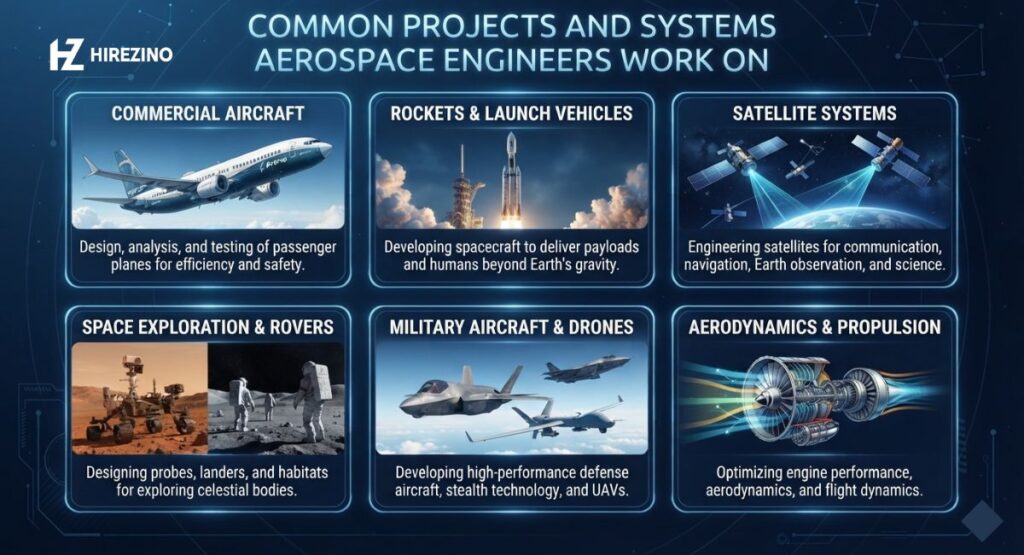
Aerospace engineers are employed in developing commercial aircraft, space probes, and other systems. What is the work of a Aerospace engineer on a typical aircraft project? Test design, conduct stress tests, and tweak aerodynamic features until the design is safe and capable of performing to a specific level established by regulators to ensure it can take to the air.
What other work does an aerospace engineer do on a satellite or defense project? They develop flight systems, guidance technology and materials for hot or cold conditions. What is the same for any type of aerospace project? Whether it’s a passenger jet or a Mars rover setting off on a mission into deep space, solve problems when failure isn’t an option.
On the Job Tools and Software for Aerospace Engineers
Aerospace engineers heavily depend on specialised software to design and test before building. With the CAD software, they can create models of components in exact 3D detail. So, what do aerospace engineers do with simulation tools? Understand the performance of a design when tested under stress, heat or airflow conditions, prior to the making of a physical design.
There is also a role for wind tunnels, flight simulators and engineering simulation software. What is the difference between an aerospace engineer’s today and decades ago? Use the latest computer technology to virtually test thousands of design variations. So what do aerospace engineers do with the time that they save? Reduced the cost of testing and development times significantly from previous physical testing only methods.
The skills and qualifications needed to become an Aerospace Engineer are:
A passion for planes isn’t the only part of a career as an aerospace engineer. The key requirements include solid math background, knowledge of physics and an aerospace engineering background. What does it take for an aerospace engineer to be successful? Gain 4 years of intensive and challenging study in the areas of thermodynamics, fluid dynamics, and materials.
Many of them also undertake engineering internships during their studies, to acquire knowledge in getting experience of actual projects. How does a aerospace engineer advance his/her career? Obtain a PE license or a higher education. Once he or she has that degree, what does an aerospace engineer do? Venture into senior design, research or leadership roles at big aerospace companies throughout the country with their doors open.
What is the Difference between Aerospace Engineer & Mechanical Engineer?
Mechanical Engineer: They make plans for general machinery, including engines and manufacturing machinery. Aerospace engineers are experts on planes and rockets that fly, the science of designing them and an understanding of aerodynamics and orbital mechanics. This is one thing that an aerospace engineer does, which isn’t taught in mechanical engineering.
Why is there an added specialization on an aerospace engineer? Operate in extreme conditions of altitude, pressure and speed, which ground based machinery never operates. Which one of the following is NOT typically a mechanical engineer’s job? An aerospace engineer?Which of the following is NOT typically a mechanical engineer’s or aerospace engineer’s job? Explain in detail the physics of flight and the issues of space environments, with much more detail than mechanical engineering courses. There are many different stakes and different environments.
Aerospace Engineers Workplace. (Industries and Employers)
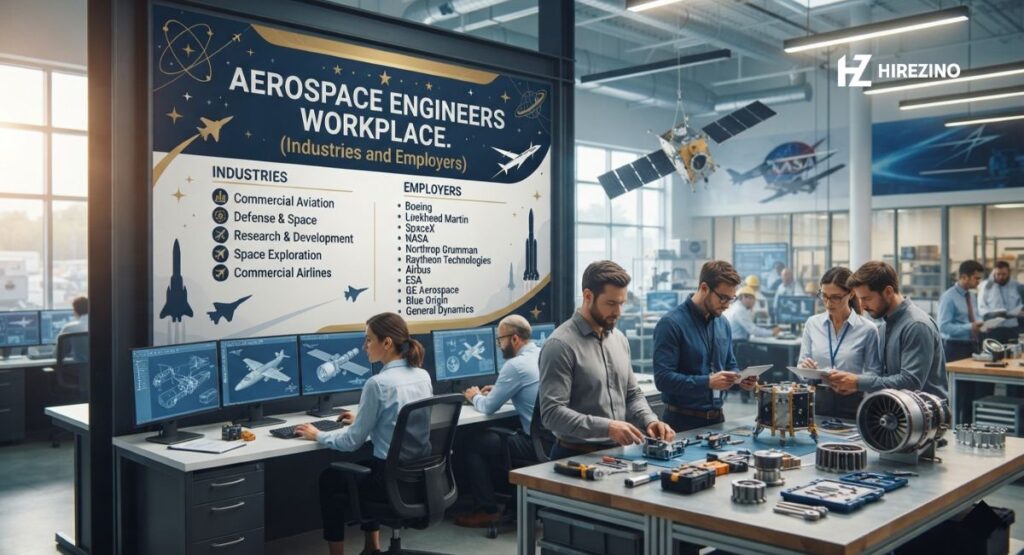
There are several main industries in the USA where aerospace engineers are employed. Many go to work at a defense contractor making military aircraft or missile systems. Others are employed in commercial aviation, developing passenger aircraft for the major airline companies or as a NASA engineer involved in space exploration projects.
| Employer Type | Example Focus |
| Defense Contractor | Military aircraft, missile systems |
| Commercial Aviation | Passenger jets, cargo aircraft |
| Space Agencies | Satellites, spacecraft, exploration |
| Research Institutions | Experimental aircraft, new technology |
What are some of the changes in the profession of aerospace engineering in these areas? In general, people need to have a security clearance to work in the government and defense sector. Then what do private aerospace engineers do? Work faster, have earlier market launch of commercial products.
As such, what is the salary of an Aerospace Engineer? (2026 Salary Guide)
Aerospace engineering pay is high, and it’s due to the special expertise required in order to be successful in the field. What is it that makes a big bucks aerospace engineer? Create and solve complex design problems, specialize in propulsion or avionics, assume senior design or large company project management positions.
| Experience Level | Average Salary (USD) |
| Entry-level | $70,000–$85,000 |
| Mid-career | $95,000–$120,000 |
| Senior/Lead Engineer | $130,000–$160,000+ |
What does an aerospace engineer do when choosing a employer for the best pay? Target defense contractors and space agencies, since location and employer type both affect compensation significantly across the country.
Benefits of Pursuing a Career in Aerospace Engineering
An aerospace engineering job is very stable and is challenging intellectually. What is all about an aerospace engineer? Design projects to enhance human ability: safer aircraft, spacecraft to explore beyond our solar system.Plan designs to expand human capabilities: safe aircraft, safe spacecraft in outer space.
What pros and cons are there to the career of an aerospace engineer? Take time to learn, since new technology is being developed all the time, and new materials and propulsion systems are being invented. Which few jobs have a job like an aerospace engineer? Include a constant demand, competitive salary, and a chance to shape and impact the future of flight and space travel for generations to come.
Conclusion
But what is an aerospace engineer’s job at the end of the day? They design the aircraft which carry millions of people, to safety, and the rockets by which they send people into the unknown. These professionals can work on propulsion systems, avionics engineering, or on a whole new design of an aircraft and can transform physics into flying machines.
Learning what an aerospace engineer does also assists aspiring engineers to chart their careers. You’ll understand why an excellent aerospace engineering degree is important, how each of the two primary aerospace engineering disciplines, structural and systems engineering, differs, and why aerospace engineering continues to be among the most respected and lucrative areas of contemporary engineering.
Aerospace engineering is not merely a career; it’s a discipline that brings dreams to life in the form of aircraft. The next time you are watching a passing jet or one launching on news, you will know what aerospace engineers do to bring that about.
FAQs
What does an aerospace engineer do?
An aerospace engineer designs, tests, and develops aircraft, spacecraft, and satellites, focusing on aerodynamics, propulsion, and structural safety.
How long does it take to become an aerospace engineer?
Most complete a four-year aerospace engineering degree, with some pursuing an extra two years for a master’s degree.
Is aerospace engineering a good career?
Yes. It offers strong salaries, steady demand, and the chance to work on cutting-edge aviation and space technology.
How much do aerospace engineers make?
Entry-level aerospace engineers earn $70,000 to $85,000 per year, while senior engineers often earn $130,000 or more.
What is the difference between an aerospace and mechanical engineer?
Aerospace engineers specialize in vehicles that fly, while mechanical engineers design general machinery and equipment.
Do aerospace engineers work for NASA only?
No. Most work for private companies like defense contractors and commercial airlines, not NASA directly.